
In Pokémon Ruby and Sapphire, we are told of Stantler, one of the Gold and Silver Pocket Monsters, “Stantler’s magnificent antlers were traded at high prices as works of art. As a result, this Pokémon was hunted close to extinction by those who were after the priceless antlers.” Stantler’s other PokéDex entries allude to how precious its various parts are, as a commodity. (The Pokémon universe somehow makes a distinction between catching a Pokémon, and hunting it.) “The round balls found on the fallen antlers can be ground into a powder that aids in sleeping.”
Stantler’s appearance – with its large antlers and its cloven hooves – clearly allude to the caribou. The caribou has been hunted by indigenous people for generations, but its antlers are used in larger-scale hunting operations as an aphrodisiac in international illicit markets. One species of caribou – the Queen Charlotte islands caribou – was declared extinct in 1908, after decades of over-hunting, and the caribou’s IUCN status is “vulnerable”. The boreal woodland climates that the caribou formerly inhabited are changing unrecognisably, and the Siberian tundra reindeer is in terminal decline.
The latest Pokémon games, Sword and Shield, overtly address the reality of climate change. The most obvious example is the bleached coral Pokémon, Cursola. For anyone who remembers fishing Corsola in Gold and Silver (it seems to me almost like an idyllic childhood memory, since I grew up in a post-industrial urban Northern English town), the sudden appearance of Cursola – A Ghost-type Pokémon which inhabits the spots where the coral Pokémon (corsola) once was – is eerie. It brings the Pokémon universe in line with the fact that, everywhere, coral is dying. Then, of course, there is a new form of Weezing, that looks like a smoke stack. Yet these are only the least subtle ways in which the new Pokémon games comment upon our evisceration of the natural world. For the first time, the National Dex has not been included. Stantler – like many other Pokémon introduced in previous generations – has been completely erased from existence.
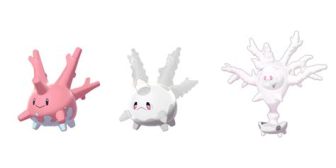
This has perceived as being an effort to simplify the games, yet surely it has a similar significance to the sudden creation of “climate change Pokémon”.If the existentialist-looking Cursola now exists, instead of the beaming Corsola, then it’s perfectly possible that some of the other Pokémon have simply died off. If Stantler’s PokéDex entry warned that it may well die off, it is readily possible that it has actually died. In other words, the Pokémon universe, which has been alluding to the endless biodiversity of our planet in its constant expansion, is now displaying to us the reality of the global ecosystem. The Pokémon creators can no longer increase endlessly the amount of Pokémon, if there is to be one twinge of realism about the games. In the non-video game universe, which Pokémon draws its inspiration from, new species are evolving at a much slower rate than that they are being permanently wiped from existence. Animal extinctions simply occur: we’re not warned about them. They happen in exactly the types of fragile landscapes that we have fled from, or bulldoze. They happen largely as an insignificant backdrop to human-centred news. It is a tragedy when a large volume of human beings die, yet it is an equal – and, in many ways, greater – tragedy when a whole species goes extinct, one that we have no framework of reference to deal with.

Stantler no longer exists, and look at the Pokémon that now do. It’s not just Galarian Weezing, and Cursola, it’s all of the other Pokémon that they decided not to kill off. Trubbish – a dark, green rubbish bag from Generation V, surely a throwaway Pokémon if there ever was one – has not been killed off. Who on earth has any attachment to Trubbish? As someone who played all the Pokémon games when I was younger, I couldn’t give two Hoothoots about a Pokémon based on a refuse sack, but I actually remember being a bit excited when a wild Stantler would appear in Gold. But that’s the point; climate change is going to leave us with only slathers of Poison- and Ghost- type Pokémon.
There are so many more examples of this, but one of my favourites is Galarian Slowbro. There is a new form of Slowbro, which is Poison-type, and its PokéDex entry tells us, “If this Pokémon squeezes the tongue of the Shellder biting it, the Shellder will launch a toxic liquid from the tip of its shell.” The poisonous oceans are infecting the Pokémon we remember. Many of the other Pokémon, which were based on exotic, rare, threatened animals, are also omitted. Girafarig, a giraffe Pokémon, Donphan, an elephant Pokémon, Relicanth, a coelacanth (the West Indian coelacanth is critically endangered), and many others, are not included in the new games. Since so many of the real-life counterparts of these animals are critically endangered, it stands to reason that they are no longer present. The Pokémon that remain match more closely the mutated natural world which we actually inhabit. There is a Pokémon based on constellated lumps of coal (Rolycoly) and a Pokémon based on a gigantic skyscraper (Duraludon).
The fact that Pokémon can, and will, go extinct, is testified to in the fossilised Pokémon that one could resurrect from the initial games, like Aerodactyl. The new Pokémon games carry a savage warning. If we continue to destroy the natural world at an unprecedented rate, not only will we destroy the real world, but also the virtual world.

 Squidditas