Whaddupp, my name is Sam Hickford. I am due to graduate my PhD from St Andrews in December. I wrote about Clare and contemporary poetry. I have a book, Poems Sketched Upon the M60, published in 2021. I have quite a few academic papers which you can find here: https://www.researchgate.net/profile/Sam-Hickford. I publish other people here too, but unless it is signalled that someone else is the author, I am the author.
I went down to an open mic in Manchester on Monday. It was very sweet; a rotating tapas board of folk singing of thwarted love, cosmic interplay, and how shit everything it is. I respect all of these themes.
Apparently, the procedure is to record the set, so here are a few photos and videos of me performing. Let’s see how long they will stick around on the fluidity of the internet. Please check out the other performers, too, and you may flimsically flamily flamingishly wish to go down to the Flour and Flagon on a Monday night.
This is forthcoming in this week’s print edition of The Tablet. I wanted to write a piece about how we might create some sort of utopia in my unutopian home town, starting with fostering a whirlwind of multi-lingual and multi-racial tablet. Thanks to Brendan, who turned my Blakean reverie into something publishable with
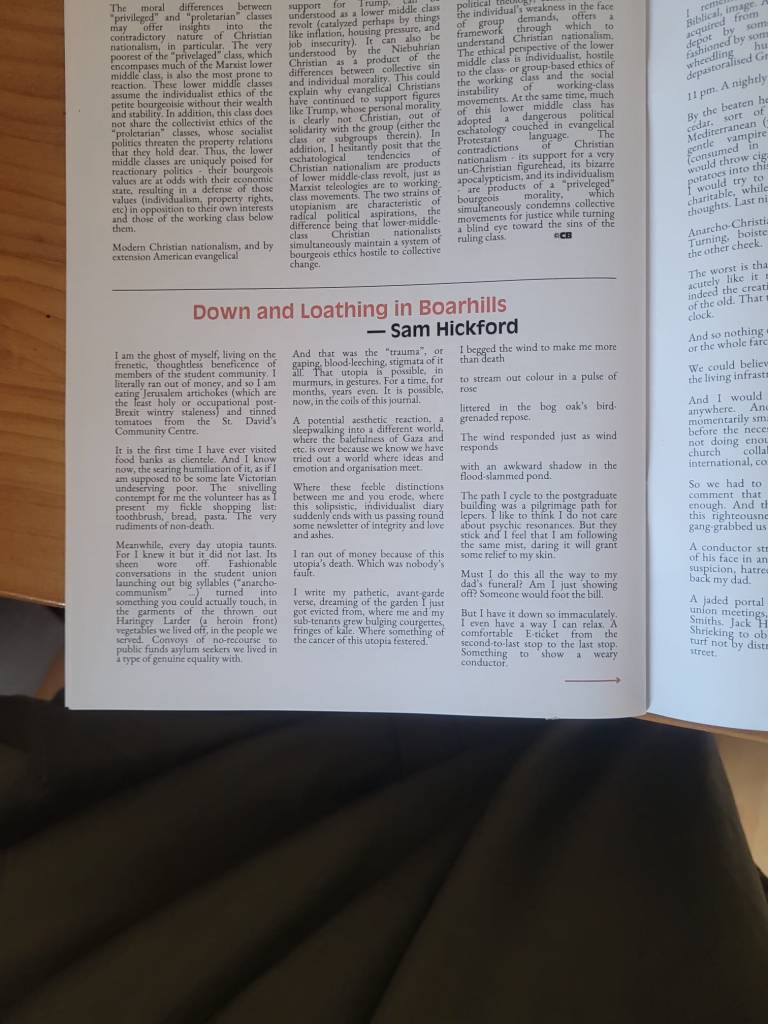
I am working on something called Down and Loathing in Boarhills. It is a work of fiction. An extract of it was published in Counterblast, a whirlwinding grassroots magazine seeking after authentic expression of injustice, doing more than others to grapple with the reality of our global human condition, the precarity of our artificial borders, and aiming to speak out in hopeful projectiles. It can be found here, and some physical copies can be purchased: https://counterblast.uk/. Peace, Sam.
When I went to a psychiatrist at fifteen and was given, alongside a diagnosis of Asperger’s Syndrome, “depression with mild psychosis”, it was the “psychosis” that most stung, and that I felt most ashamed of. Instead of admit to people at my school that I had “psychosis”, which has a terrible name, I feigned some kind of mysterious, verbose-sounding head injury (“occipital neuralgia”).
Depression and autism are both derided and misunderstood, but they both have slightly positive representations, even if those positive representations are inaccurate and often stupid. Sheldon Cooper eventually gets a girlfriend, while the “Black Dog” gave Winston Churchill the ultimately realistic outlook to defeat the Nazis.
While people with depression and autism struggle, it is psychosis that still remains totally maligned, misunderstood, and resolutely unsexy. Picture someone with psychosis and the first thought is that Alfred Hitchcock film, Psycho, or Jack Nicholson hacking a wall with an axe.
These prejudices pass to the psychiatric profession and to personal relationships. Mention to someone that you “hear voices”. Psychiatrists will often ask you “what the voices say” or “do the voices tell you to hurt people?” Girlfriends, and friends, meanwhile, will run a country mile, even if “depression” and “autism” can be cute, plushy signs of macholessness.
I hear voices. And, no, these voices do not tell me to ‘hurt people” or to hurtle an axe into a wall. Quite often, they don’t “tell me” anything. They are more like a malfunctioning computer, a high pitched sound emitted from a broken TV. Often, I will hear the voice of people I know, singing a note, while not actually singing any particular word. There is no message. Or I will hear bodies of water, rivers, oceans, running, that aren’t there. Or I will hear creatures that aren’t there.
Yet when I am tired also people’s voices will remold themselves into actual messages. These are usually negative, and deceptive, but still don’t involve commanding me to do anything. But they are fearful. When I was a teenager I would frequently hear a familiar voice saying, “I am coming to get you”.
But they can also be positive. They can be familiar tones of people I like heard at the creak of a door. There is a particular door that I open near my office and it reminds me, every time, of the distinct, imperceptible hum of someone that I like, a lot.
So saying “hearing voices” is a simplification. They are auditory hallucinations. They are a little like dreams, except your mind is carrying over concepts from dreams into reality, and asserting the rational part of your brain takes actual work. They are made worse by tiredness or hunger.
They are also a little like an imagination gone wild, or wrong. And imaginations are good, and necessary for writers, artists, and children, as well as everyone else.
So, in other words, “psychosis”, like depression or autism, can often be unpleasant, and undesirable. But there’s also a creative component to it. If it is well-managed, and the rational part of yourself is strong, it’s even possible to control it, to snap out of it.
This is something that medical professionals do not seem to understand. Nor do religious people, often. The religious response to saying you “hear voices” is often to declaim you as a fraud, or a madman, who needs the grace of God. Who needs healing. Not that you might, just might, have the fragments of an authentic, prophetic gift (while clearly not being the God, or the Messiah, etc.)
Our inability to take people who hear voices seriously leads them to the extremes of proclaiming themselves to be God.
So this is why I am writing this, here, now. Because I think that hearing voices needs to be less taboo. I think we need to be able to say, without societal derision or fear. I have had two points in my life where the hearing of voices has actually been an assault.
But in the last two years the condition has been well-managed. It will never fully go away. But part of helping “psychosis” not to be aggressive, or uncontrollable, is to actually take the content of what people with “psychosis” are actually saying seriously, and to have an awareness that hearing voices is something that a lot of the population report. Not just axe-murderers.
If psychotics are given the space and trust to share their visions, they will be better, and society will be better, able to incorporate the extreme creativity and originality they are able to showcase.
People have only admitted to me that they hear voices under the most extreme promises of confidence. This should not be the case.
We are heading towards a braver new world of e-parenting, or tele-parenting. Diminished is the genuinely absent parent; the absent parent is often available virtually, if only a child’s attention span can access them.
For one of my friends with daughters, their father is not available as he frequently is away, working on an oil-rig. But, from the oil-rig, he has data, wi-fi, so he can organise little video chats with them.
For me, virtually my only contact with my child has been online since just before he turned 2, for reasons I shall not go into.
During the pandemic, I worked in care homes, homeless shelters, and was an online tutor. I never had a job that involved excessive Zoom use. I also have this little thing called “autism”.
We spoke virtually before he could even speak. This is not an intuitive way to speak to a non-verbal child. How do you tap into a child’s emotions or practise non-verbal communication electronically?
When my son did learn to speak, I missed his first word, and had to learn how to understand his speech, or see the developments in his speech, via Zoom.
I think, after this situation rages for two years, it is only recently I have begun to learn what to do. I think the key was to incorporate ideas from online tutoring. I’m trying to learn never to just waffle, and keep every single activity, dynamic, reciprocal, and engaged. So it’s not “read stories” but co-create stories – talk about characters, ask if he likes words, ask what he thinks will happen next. I have written stories with my son together online.
Part of this is using the screen share function, and reading an old children’s book while pointing out pictures, slowly reading.
But the problem is that seeing parenting a three year old online as “teaching” is also problematic. It’s extractivist, for one: kids of that age do not need militant educational programs, pushing them to build their vocabulary. At that age, children can, for once, be free of expectations to accumulate knowledge.
So it’s with reluctance, and nervousness, that I’m experimenting more with play, even if there are innate technological limits. Puppets were a great discovery, but can you stage an online puppet show for a three year old? It’s an interesting challenge.
Similarly, can you actually play hide and seek online? Or how hard is it to synchronise different activities, or talk about what would work together, often with difficult emotions and atomised family units after a relationship?
I used to love taking my son to museums. But it strikes me as I write this that, for a child, it could be pretty much identical to just get the British Museum website up and look through the exhibits online, and respond emotionally to what you see together. What is this? What is that? I’ve often found myself just randomly listening to stuff my son says and trying to approximate what he’s talking about with my own ideas. I spent a long time recently looking up pressure cookers after he was talking about a “flat thing that makes steam come out”.
Yes, it could be fun to write an e-mail together while virtual parenting. Admittedly, it feels so much inferior to being there. But I suppose part of the challenge of the twenty-first century is we will have to get over that sense we have to “be there”. Families will be increasingly divided and learning how to digitally parent may save us all.
And it’s never going to be the same. But it might be, sometimes, as good, as real parenting, if we put enough work into it. But we need to put the work in, to prepare, because nobody knows how to teleparent a child. It’s an unfamiliar concept that our parents and parents’ parents had no notion of. So I’m writing this as a starting point to prepare some idea how of how to parent when forced into a situation when digital conversations are practically all you have.
The default presentation of poetry is from the lectern. This is a phenomenal presentation of Protestant piety. Poets at readings are largely consigned to the role of Anglican priests, gently entertaining their flock. Invariably, people are sitting. Invariably, the poet does not know their work off by heart.
In the “Prologue” of God’s Gift to Women, Don Paterson mocks these conventions richly, and the general tone of poetry readings. We’re at a poetry reading, we proudly announce to ourselves. They become enlightened opportunities to show we “get the clever stuff”. They become boringly fraudulent activities, where we finally put to use the expensive literary training (either financially or temporally) by a network of sighs and snorts.
Elsewhere, Paterson also mocks these conventions, beautifully, in 40 Sonnets. Poets are sorcerers, magicians, encouraged to talk in the gaps of their poems but certainly not actually read them. “Anything but read your poem”, the audience is imagined to demand. Legend has it that Paterson became so bored of readings that he no longer does it.
I thought I could upend the whole customs of poetry readings. But what are the alternatives? And are we ready for them?
The griot – the troubadour-historian, for example – retells, in verse, the history of the people. Can we be this? Can we train ourselves to do this?
In a culture obsessed with specialisation, perhaps not? Is there a market for a good griot?
We are shamefully aware, for example, that peppering our cryptic verse (for our verse is cryptic if it is mysterious to… the people….. the pub… the crowd at Spoons… the guy under the bridge…) with musical interludes exposes our incompetence. In a culture where “to sing well” is to be able to shoot dopamine into someone’s face, the kind of light, lilting singing that inevitably accompanied an entire history will take ages to work. It will be a gradual cultural process. Nobody in this lifetime will reinstitute the folk storyteller, the troubadour, hobbling from place to place.
So let’s chip away at it? In my Fringe show, a poetry reading, I tried to abolish not only the lectern but the concept of applause, the idea that readings should not have musical accompaniments, the idea that poetry readings should necessarily be soporific encounters. For that is what marketing demands. It is keeping the youth away. Probably.
But I am equally not interested in the alternative. The alternative, I realised, is that we become comedians. And that, therefore, to some extent, our poetry becomes therapy for ourselves, and for the audience. A ritual of immolation, for comedy inevitably directs somewhere. We are shooting for laughs, or for sobs, in other words. And the only way to do this is to expose ourselves so much that we become loud……
So why can’t we learn to shut up? To perform poetry as sacred ritual? We already have the lectern for that. Why not stand our books on the lectern, and use them as springboards for incantation, reverie? With an explicitly religious focus, we can get away with the bad singing. It is excusable as praise.
But ultimately performers, at least today, are only ever drug dealers. You pay 5 pounds for a dopamine hit. What you should perhaps be paying for is a poet to truly lodge him or herself into your skull. For their words to become your landscape, your pavement. Perhaps paying for love. And, if we poets know how to do one thing better than carpenters or shepherds or AI programmers, it is to love.
How can performance not be drug dealing? Certainly not at the Fringe. I think we need to reinstitute the procession. Let them pay 5 pounds to dance, scatter dye, wear masks, and recite. Then afterwards we will try to sell them our small-press books.
Maybe I should have somehow perfected my show. In some crystalline structure. Panicking, I get Instagram, in a desperate effort of promotion. I have always flattered myself that Instagram is the last bastion of social media that I have not defected to. An uncharted territory. And I imagine some baleful reality, the continuation of some awful “for now”, where I have this forever, and I am doomed, in some circle of hell, to look at Reels. Meanwhile, everything else distracts, such as the awful agony, etc. https://tickets.edfringe.com/whats-on/brother-smudge-s-strange-meditation https://www.instagram.com/brothersmudge163/
Clive Scott posits in discussing eco-translation that our very alphabet divorces us from our lived environment. Our alphabet is overly precise, logical, and bars the phenomenology of reading.
Abjads, scripts in which vowels are implied, embrace ambiguity, and maximise space. The experience of writing a scripts in which vowels are explicit is the pursuit of a democracy that barricades the existence of reading in time and space.
Our left-to-right reading punishes the traditional understanding of reading as a wheel, as a sequence of spokes. Mesoamerican scripts, for example, use a boustrophedon, connecting writing to the plough. The signs themselves are structures.
For writing in this period was destined for inscription. Thus, the kind of two-dimensional writing we usually see now would have been impossible. While writing is ubiquitous, we are pummeled daily with flat, left-to-right writing. Including this.
In Ogham, another boustrophedon, sed for funerary inscriptions in Ireland, the tally-like signs, apparently derived from Latin characters, designate parts of the body, or trees. There are mathematically related symbols for “elbow”, “pine”, and “willow”. And earth.
Funerary inscriptions must be brief, yet sacred. They must spin meaning from tiny fragments of lines, and be readily-carveable.
Both the expansiveness of our need to represent vowels, and our left-to-right writing, imprison us in certain cognitive patterns.
Is it thus to develop a new system of alphabet? Unfortunately, divine revelation does not produce the best alphabets. Malia Gomango received 24 letters of Sorang Sampeng on a vision in the hills. While the letters he developed may have been shaped by the hills in which the new alphabet was given to him, the alphabet’s lack of connection with bartering made it unsuitable to carry divine texts.
For religion and divinity is waging, bartering.
What about cup-formed numbers? Abjads? The kind of compromise I’ve been thinking about with English is destroying our sensibility of it as a left-to-right language. What if it is a top-to-bottom language, as apparently in Ge’ez? Or a purely rotating language, as the Hawulti monument. This monument rises and cycles in the cyclicality of its inscription.
But it must remain of the earth. Abjads ensure only what is strictly necessary is written. But, in turn, they limit writing.
But our own phonetic palette is getting thinner. And so cuppoetry restores visual language to its logical, rational, aesthetic principles, leaving us to imagine the phonemes in between, recreate phonemes, restoring spoken language paradoxically to its primacy.
Cup-poetry wraps around our skin like a bandage.
It is of the environment insofar as it uses items of commerce for visual-linguistic voyeurism. In other words, we poets are linguistic pigeons, defying, in a small way, the logic of mass-production.
Consider Hankul script, for example. Uniquely, it is arranged into syllabic blocks, into newly symmetrical patterns. Written language, by its sheer beauty, is divided from spoken language.
Cup-poetry allows no punctuation, since punctuation only makes sense in right-to-left reading. Writing as it has been experienced for the majority of humans, without the unnecessary need for word-dividers, is restored. Or, word-dividers are compulsory, rather than optional. Punctuation becomes a mere cyclical organizational principle.
Or so we hope. Or delude ourselves.
Each linguistic character is a face, within the cycle. A seeing, breathing, sensing artefact. A reality. A metallurgy. A bronze statuette, scanning the three-dimensional realm, engraved in our environment.
Join the cup-poetry revolution.
Meanwhile, I hold in my hand an abjad-poem. Every reading is entirely different, as some part of my cognition is creating, automatically, a different poem. A new text in a wholly sonic and semantic sense. This is not the poem I composed in my head. It is an odd, cycling shorthand. In one of so many instances, ‘ply’ is ‘play’ or ‘ply’, is ‘ploy’. My mind is forced to decipher. And, in deciphering, we are creating.
This is partially why it occurs to me that so many texts cannot be deciphered. Because they are polyvalent, to use the term of grammatologists. They have multiple possible meanings.
(Also to be discussed: John Clare losing all his vowels, so his brain becomes an abjad.)
Jack Hilton’s Caliban Shrieks, re-published this year, is a work of picaresque modernism, closer to the early fragmentation of picaresque in the sense of its idea of unfortunateness as a bitter satire of an increasingly fractious, displaced, unequal cityscape. In this regard, the comparisons to Thomas Nashe’s The Unfortunate Traveller seem exceptionally pertinent, therefore opening the apparently unique fragmentation of modernism as a comparison with earlier styles. The erstwhile protagonists of both picaresques are often being locked up, and the grotesque conditions of their locking up mirror those of their respective times. Caliban Shrieks, tanked with Shakespeare references, no least to the character who is at the margin of an island he uniquely understands, captures the brute reality of early twentieth century prisons:
“You are ordered to place your cards in the frame outside the door. Then the warder – from now on called screw – looks up and down to see us all in miscellaneous forms of attention, and again indifferently chirps ‘Into your cells.’ Once again there’s a rhythmic banging of doors one after the other, and the grating of the key. You look round at your home, and find it like the one you left behind just after tea with the addition of a bed board of three planks’ width and nearly seven feet long, with two batons underneath to raise it about three inches from the floor.”
I like here the way the picaresque collapses character, that character is replaced by invective, derision. It compares resonantly with a passage in “The Unfortunate Traveller”, Nashe similarly understanding the fate of being tossed into prison long before human rights, detention limits, merely the sheer fear:
“I could drinke for anger till my head akt, to think how I was abused. Shall I shame the deuill and speake the truth, to prison was I sent as principall, and my master as accessarie, nor was it to a prison neither, but to the master of the mints house who though partly our iudge, and a most seuere vpright iustice in his own nature, extreamly seemed to condole our ignorant estate, and without all peraduenture a present redresse he had ministred, if certaine of our countrie men hearing an English earle was apprehended for coining, had not come to visite vs.”
This is to avoid dwelling on the other countless similarities between Caliban Shrieks, and classic Elizabethan picaresque modernism, such as its reliance on wheedling allusion. It is to initiate an understanding of a fascinating, undiscovered writer, who lived in my own town of Rochdale, and equally stretches beyond it.
 Squidditas