Volunteer for Transitions, for StA Reuse, for the various community gardens around campus (by the Observatory / in St. Mary’s Quad / by the School of English / by Gannochy Hall / by Computer Science / etc.) Volunteering for the community gardens, you will become acquainted with what is growing, with the fresh produce there, what needs harvesting. On the other hand, volunteering for the reuse warehouse (a garage by the Chemistry Department), you will come to have a sense of what previous students are donating. The chances are that someone was unable to fit in a van back to Bridlington or Beijing the exact hoover, microwave, or combine harvester you are plotting in your mind. Everything apart from clothes is free in the St. A warehouse, so you will spend practically nothing on this.
Volunteer also for the various soup kitchens in town. You will definitely get entirely free food this way.
Try to avoid buying coffes and teas around town. There are lots of ways to do this. There are free hot water taps available in the Main Library, the Old Burgh School, and the PG Lounge in the Butts Wynd Building. But Greggs probably sells the cheapest and nicest coffees of all, at something like £1!
If something isn’t available in the Main Library that you need for an academic project, you can secure it by Inter Library Loans: https://libguides.st-andrews.ac.uk/InterLibraryLoans. You can secure practically any book this way. But be sure to return it in a timely fashion as you will be charged.
Also, you can get practically any book on archive.org.
Be attentive to what student societies are doing. Since these attract funding from the student union, they’re often able to run cheaper events. There are free yoga classes available with YogaSoc next week, for example, check their Facebook page. Sometimes the Sports Centre also runs free exercise classes. Etc. Blah blah.
CEX and Cash Converter in Dundee, which I forgot to mention before, sell second hand electronics, bikes, and watches.
Use Facebook Marketplace and freecycle fairly religiously to find what you need.
Ostensibly the quietest place to study in town, with a culture of absolute silence, this library is perfect for extremely disciplined, silent, concentrated reading, or for a two-hour burst of thesis writing. I try to schedule a small burst of Martyrs Kirk – it’s a very potent, powerful, contemplative drug, and if you can only ever study in here you have the discipline of an ancient Carthusian mystic. You might find it annoying, for example, that there are no actual real books here that aren’t some sort of tome, or that there’s not even a space for light chatter somewhere off-stage.
Main Library
This gets very full in term time. There is supposed to be a quieter bit downstairs, with a little bivouac of a postgrad area, but it’s usually not very quiet, with reels of lads talking about their hunting ventures. You can book study spaces.
Byre Theatre
A former cow shed or whatever, people apparently study in here, but I’ve never fully understood why, with mills of the professional cultured class rifling through its plate-glass-stone faux-London beauty. It’s true, however, that it’s a big building, and you might be able to find somewhere to study on the second or third floor.
Old Burgh School
The home of St. Leonard’s College, this is a quiet building with a stable cast of people who know about it and work there. It’s a supportive community that feels reliably “adult” and enough like a workplace that you often feel guilty enough to get work done. Too much time there, however, might lead to chronic lack-of-inspiration-itis, as you forget that you are supposed to be at St. Andrews to be inspired, or half-inspired, not put together some sort of marketing Excel spreadsheet. If it’s any consolation, however, my son loves it here.
Outside
Should I admit to you, gentle, sensitive reader, infirm of heart, that I have actually done a huge amount of my PhD reading atop a croodling sycamore outside the Brutalist edifice of the Main Library? What I find handy about it is it’s proximity to the library, where the actual books are. But there are other outside locations where study may be carried out, such as St. Salvator’s Quad and a few church courtyards, such as just outside All Saint’s Church on North Castle Street, or on the East and West Sands. I have also done a huge amount of my work in a tiny little grove near Ayton House.
Cafés and pubs
I think the only pub or café I have ever worked in in town is Aikman’s. I have worked once or twice in The Canny Soul and the Granary Café in St Andrews Museum, both of which seem to be cafés that people don’t often meet for dates or gawp at gigantic statues of William and Kate in.
Like a tooth it fell, or like a tusk, lodged loosely in a gum, rootless, slipped to prop against its neighbour.
There is always one, askew on the edge of the pillared dark its fellows make, straight and bottle-brush-wilted, but
some green moves yet – not leaf, but there on needles pressed to softness, an inchworm arches, finds purchase, relief –
as on my palm its teeth made new lines, made creases questions, refused to grip on plastic, nail or glass, as on the bark
now, on the trunk made whole by inattention, let it open ridges into mysteries. Let it teach how to remember you are an earth-made thing.
This is a literally oral poem: poem as struggling mouth, with all the attendant features of a child, wanting to speak. Challinor, or so I imagine, selects a gem from this oral ecosystem, understanding it as a glittering presence, trying, within the sagely magic of poetry (see Yeats etc. etc.) to slot it back into place. A felled pine may as well be our soul, with a few moment of child-kindling mysticism.
The poem jolts us back to the organic nature of ‘gum’, as if to chew is to contain the forest in the arboreal panorama of one’s mouth.
I’ve lived in St. Andrews for a year and a half and had to care for a child while unemployed, then worked a combination of jobs while supporting myself as a delivery cyclist, PhD tutor, online tutor, and tour guide. I have never had a reliable, stable income nor any kind of PhD stipend. I had a tuition fee waiver, and that’s it. Nevertheless, survivalism in a town full of reality-divorced posh golfers can be a fun challenge. In case you’re about to be a similar position, here is every tip I can think of right now, though I know some more:
University of St. Andrews meal deal, available in the Main Library, Walter Bower House, and other University-run (not Union-run) cafés (somewhere in the North Haugh?). £1.75 for a reasonably priced sandwich, snack, and hot drink (filter coffee/tea). This has saved my life when I haven’t got the time to bring some food in a Tupperware (brandonym redacted?).
Tesco on Market Street have a reduced to clear section in the middle that often includes a diversity of food. They throw everything away at about 9 pm so get there before that.
Budget shops: There is an ALDI. That’s pretty much it, unless you count Greggs. But, In Dundee, there is a B&M and a Home Bargains. Make these your friends.
Similarly, if you’re too old for an Old Scot Card, bear in mind the University’s Stagecoach discount. You can get 75% off weekly tickets, which is a huge help. A weekly East Scotland ticket will cost about £7, which can get you to Edinburgh, Glasgow, Dundee, and possibly Aberdeen (staying out too late in Glasgow or Edinburgh may result in you getting stranded without the Elemy service, which is reasonably priced.). You need the St. Andrews logo to come up on your app. For help, go to the Main Library help desk.
Also, as a student, you are entitled to a 16-25 railcard even if you are over 25. This is important and will help a lot in getting to conferences, going home, etc. You need to go to the ASC and get them to stamp a physical railcard application, proving you’re a student, and then you’re off. It’s about £20 and well worth the money for a third discount on all standard tickets.
Bear in mind random soup kitchens, in St. Andrews churches, which happen a lot. St. Mark’s Parish Church, a Church of Scotland church near the bus station, has a free soup kitchen on Friday starting at 11 am. Don’t think that you are ‘taking food from people who truly need them by doing this. Considering how messed up the university sector is, you deserve free food, unless you have some sort of expensive trust fund, in which case maybe you should consider setting up something like this. There are more, too, and many in Dundee.
Similarly, St. David’s Community Centre, North East Fife Community Hub, near East Sands, on Albany Park, has an affordable lunch every weekday in which you can get a big lunch replete with much genuine nutrition for about £3. Food banks and a post office are run from here.
Bikes: Transitions have bikes you can borrow and a bike workshop where interested volunteers will help you repair your bike and not charge you extortionate sums. There’s a really nice chap on Kinnesburn Road who runs a bike shop called Cyclepath. Do not go to Spokes on South Street. These guys are notorious overchargers who will do whatever they can to ensure you pay overpriced sums for a simple and uncomplicated bike repair.
More on transitions. Transitions’ various community gardens have harvestable produce that is fit to bursting. Among the Transitions gardens that are easily accessible is a garden by the Observatory (nearby David Russell Apartments, where you may be.)
Similarly, Transitions run drop-in sessions in their garage on Monday and Friday from 12.30-2.30 by the back of the Chemistry department. This is often extremely nice stuff that posh students have got rid of. You can get virtually anything here – clothes, electronics, etc. I have got a blender, a wardrobe, and several furniture items for free here.
Use apps like Too Good to Go (which operates in St. Andrews) or Olio.
Consult In The Loop, the staff and PG newsletter. If you say you need something and make a case for why you might need it someone will often get in touch with you. I have acquired a washing machine and two sofas this way.
Housing: Landlords and landladies will often charge hefty prices, considering they know the housing game. Many of the student letting agents are notoriously immoral in terms of inflating prices. Look around for more ad hoc arrangements in Facebook pages like Get a Room. If you ask your department administrator to circulate a request for housing, something might come forward.
Also, near Leuchars, there is some amazingly cheap student accommodation nearby some army barracks. If you talk to student accommodation and say you are at risk of homelessness, they will move you here very affordably.
Castle Furniture Project in Cupar is supposed to be affordable and good. There’s also a similar shop like this in Anstruther.
Booze: Luvians (on Market Street) have a little expired beer box if you’re looking for something a little fancy to impress at a dinner party or posh student party, or just want to treat yourself, but, like me, are practically destitute. Obviously the Union is the cheapest pub in town, but you might feel a bit awkward in there unless you are 18, so consider other cheap pubs in town: Aikman’s, the New Inn (I think that’s about it.) Aikman’s sell a selection of Belgian beers for about half the price they’d be anywhere else, especially some bougie craft beer pub in Islington.
Books: try Transitions, Monday and Friday, an aforementioned drop-in session. Quite often if you are looking for course reading someone will be getting rid of them. I’ve taught EN1004 and have seen the entire EN1004 reading list, together, huddled in the Transitions drop-in session. There’s a second hand book shop on the other side of Market Street, near Luvian’s, which I mention because I bear a mortal grudge against Toppings, who won’t let me have a poetry reading there (if you’re reading this, Toppings, once I become a celebrity poet at the same level of Byron, I am never letting you stock my books. If you do I will take legal action against you.)
Swimming pools, blah blah blah: The Sports Centre is obviously your best bet, but maybe you want to consider working for the Fairmont? Lots of students work here and if you work for the notorious C&B department, often commandeered by UGs, you can simply sign up for particular shifts and not work any consistent or reliable shift pattern. And you then have access to the swimming pool! And also these ridiculous 30% discounts (or some figure to that effect) on stuff like massages, the restaurants (which are not that great), etc.
Obviously charity shops are in the town. I would avoid Oxfam, which is notoriously overpriced, though it does occasionally have these massive inexplicable discounts on nice coffee and chocolate.
Naturity has a bargain basket with stuff like soya cream for 75% off, as well as free vegetables.
Finally, I would strongly recommend a trip to Kinnessburn Eco Hub. A little bit out of town, this is a very affordable refillable shop, in which you can buy rice, shampoo, pulses, etc. I have bought a massive quantity of chickpeas, rice, and shampoo and honestly spent something like about £7.
I recently had a very well-meaning and wholly lovely visit from a friend who advised me that the key to becoming a successful poet is a more coordinated PR campaign. My friend from school has also advised me this for years. I am entirely convinced that this is true, being excessively cynical about the world.
Equally, I don’t want this to be true and wish it would not, be true. Some of my earliest Facebook activity after recovering from the anodyne of a silent monastery a couple of years ago was directly ridiculing this notion. A juveniler me would tag myself at locations I’d never been to and write poems as if I was there, in direct and pretentious-prickish satire of the idea of a dramatic monologue. (I was recently called a pretentious prick, jokingly and banterously, twice, while giving guided tours around St. Andrews, so the term is on my mind a little.)
Maybe I can pinpoint what finally made me cave. Picture this scene, reader; FlixBus from Glasgow to Manchester, get in to Manchester Central Coach Station at 2.30 am, there’s a guy walking round the coach station shouting at everyone in sight, you get a coffee in a 24/7 SPAR. Then a security man in a High Viz Jacket tells you that you look “70% homeless”. You tell him that you teach at St Andrews, have a book. He says you need to buy some clothes from NEXT and then – in his words – “your students will be able to come to you”.
Maybe it is my incorrigible autism that just makes me not understand why going to NEXT is the next step towards “being taken seriously”. Are we seriously so blind towards the general import of what people are saying that we fixate on what brand they are wearing in order to decide whether or not to take them seriously? Fair enough that we think people with tattoos are cool, or that we think people with top hats are a little silly and antiquated. But having some sort of textile radar that can swoop into the whim of iron that a vestment has been branded with… surely this is a condition of late capitalism gone mad?
Maybe I’m still a bit angry at my very well-meaning boss’ boss, who flitted around the five star hotel I briefbriefbriefly worked in like an osprey, checking who hadn’t ironed their clothes and making a prey of them. Multiple times, despite doing my job very well and handling its multifaceted responsibilities well, and despite being good at schnozzing with rich people (a skill I never though I had, looking as 70% homeless as I do), it being precisely transferable to wiping arses in care homes, I was frequently given the slip by some complex chain of command that my presentation skills were not good enough. I missed a spot polishing my boots, I had urine all over my face, etc. etc.
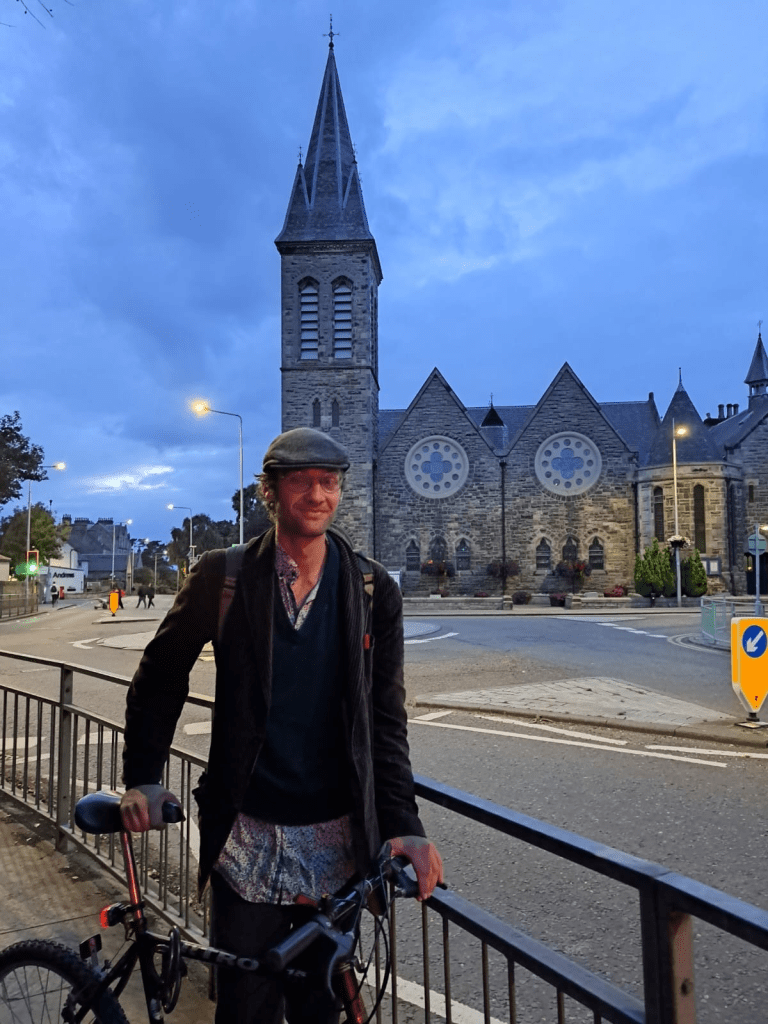
But I have caved, reader, and so this blog post is now just some pictures of me taken by someone else and an accompanying set of narcissistic photos. Isn’t that what you want? But you shall be given poems, that you shall not read, which is the only twist.
I’ve been vegan for ten years now. When I started it was specialist health food shops selling overpriced vegan food that you had to explicitly hunt for. Now being vegan is so much more accessible and trendy, but the ‘vegan market’ is saturated with samey and gimmicky food. The often dreaded ‘vegan meat’ largely looks like something vaguely resembling meat, with the tactile and olfactory consistency of cardboard. Recently, standards have fallen as supermarkets aggressively compete to corner the vegan-curious, offering fake meat products that are tantalising at first but unhealthy and bland.
I visited this restaurant with some friends in London. London is the worst culprit of this type of behaviour; ‘health food shops’ selling dreary vegan comestibles proliferate. In Camden, vegan offerings are absolutely full of poseur cuisine: overpriced experiences that should be paying you for the privilege of entering them.
So I was utterly surprised to wholly enjoy my time at this restaurant. I was staggered by the food, which is truly novel, innovative, and variegated. I had a vegan goat curry, which was the best meal I’ve had out in ten years; succulent and ambitiously structured. The waiting staff were full of genuine, rather than forced, warmth; the prices were modest.
Meat the Vegans is new, and needs support not to become another start-up erasure, so I’d really recommend doing everything you can to keep it afloat.
This poem by Michael Donaghy, ‘Reliquary’, is now more pertinent than Donaghy could have ever imagined. I think the poem is about how we unwittingly or wittingly insert ourselves into the past – how we excavate to incavate. In a volta’s fire, “The broken doll the photojournalist packs / To toss into the foreground of the wreck” is woven into the perfect alternate rhyme structure of the poem itself, as we unknowingly are the wreck we claim the vanity of having distance from. What is historical becomes actual.
The title is bathed in irony – the line ‘The death camp barrel of baby shoes’, with its invented and disturbing concept of baby saints, does not quite step into regular pentameter: we ourselves are on the same awkward, jittery journey, reading this poem, re-re-reading about the Titanic, hearing that a submersible has imploded, re-martyred.
The physical process of carbon offsetting, the paying for some questionable subcontractor to plant ecosystemically inappropriate trees, is not enough, by any stretch; we have to also invent spiritual and aesthetic means of carbon offsetting. To truly, when we are on board a plane, picture the microdot in the landscape we breeze past, even while we are diverted by onboard entertainment facilities, and raze, or help to raze, with our trip; fully Ignatian-visualise the forest we have unearthed with our selfish aviation activities.
I make these pretentious statements because I myself am guilty. I have fasted from flying for ten years, despite really wanting to travel; wanting to do ecotourism in Costa Rica, wanting to travel to the wider Francophone world like Haiti and Martinique to encounter (always selfishly, always westernly) reality, wanting to visit friends in Romania. Wanting desperately to go to the US to discover the ‘heart’ of the Catholic Worker movement I am involved in (past tense? Involved?) Wanting to see biodiversity, to have a vision of why saving the world on a micro-scale in the UK in our woefully agro-businessified and bird-of-paradise-lacking island might matter. Maybe just wanting a holiday!
But I flew this month for the first time in ten years. Given my son lives in Canada, far away from the UK, it was my only way as not a rich man and not an experienced sailor or swimmer to visit him. The extent to which this was a big deal has been met by apathy, consternation, and patience by whoever I’ve happened to tell…
…Tethered to old Britannia
a single air traffic controller
waylays into mystery…
But I remember the odd liturgies of flying from family holidays, which I was fortunate enough to go on, the sacramental strip tease, the unnuding, the odd clangorous clawing sociability of a mystery, the nudging and jabbering as we machine-learn Icarus. But perhaps that’s what the myth means; human flight is always costed. We may have seamless, even quotidian flying, but it costs the earth, weighs down upon it.
Everyone I’ve spoken to assures me I’m relentlessly justified in getting a long-haul flight to see my son. Even so, even after having paid the ‘carbon offsetting’, I feel guilty. The airplane itself, marauding with the Southern English and English-speaking Canadians, becomes confessional.
I am a supporter of XR and Just Stop Oil. But this plane journey and this reading material made me reflect a lot on my trip on environmentalist action. Maybe the apocalyptic imagery won’t wash, and in line with disruption, activists need to be more precise.
I don’t know. But one thing I imagined would be that specifically disrupting flights from Manchester to London, for example, would be a precise and effective strategy. These are planes that categorically shouldn’t run – who in their right mind is flying a trip that such a high-speed rail link exists for? But people constantly are – there are two flights a day. This seems less of an economic necessity and more the need for a seamless journey. Disrupting short-haul flights would encourage a precise debate like this.
Equally, should we ban private jets? Or restrict their use for the rich and powerful? These are all measures that, one supposes, would make sense, would begin to trigger a wider movement towards climate equity.
Or is it in nuance that we fall? Should we be doggedly emotional, and insist on the sentimental and spiritual dimension of what we’re losing? Or should we both?
It’s flattering to think that we are actually contributing to the pool of knowledge in our chosen fields, but are we actually learning adulthood? Finally, the opportunity to trawl unstalked through an obscure field of knowledge with little scrutiny, apart from the obscure demand to perform or to complete. It’s a responsibility we grow in, and maybe growing in the realms of unfettered and unprogrammed expertise a few neurons in the prefontal contex finally trigger.
I say that as someone who did meaningfully think he was becoming an expert in John Clare’s influence on contemporary poetry, and not just becoming a prelate in a generalised something. But it’s the imaginative exercise of it all – the desire to think it all matters, and matters uniquely – and the endless explaining to others why it might matter. This is a formation for the pointless career in adulthood – the needless retreat to the sideline, after years and years of maintaining a will towards generalisation, a keen interest in more than just John Clare.
—
So, do we trade? Do we hang up all our existing knowledge on the morbid coat-rack, in exchange for this expertise? I don’t know. I wish I could still reliably pretend to be a historian, a classicist, a nuclear physicist. But we instead sprint to localised ignorances in our own field.
In our field. The word is too human. Why cannot we not have untoucbed wildernesses? But to notice them is to cultivate them, to enact our stain of expertise on the living, organic realm.
We are gardeners. We are mowing our wonderfully untapped old-growth forests of knowledge.
—
But say we are growing up. We are. We are learning to distinguish, to finally ensure that what we say is mediated by authority and expertise. To not vaunt on subjects we know nothing about. To garden.
And this is by necessity a taciturnity. But must it be a retreat from activism? Can the intellectual gardener be a political visionary?
I still want to “speak up”. I don’t know what this means any more. In my saturation with expertise on one nature poet, and my awareness how little my knowledge of this one nature poet is, and the vast totality of what he wrote, from his earlier perceived days to his driftier asylum days, how can I continue to think “radically” about the plight of asylum seekers, of the growing injustices of the country I was born and have lived most of my life?
But I will. I will acknowledge that expertise must be channeled, exclusive. Equally. I will acknowledge that expertise gives us an obligation – a personal need – to develop a more integrated political voice. To speak up as this country is, in so many ways, razed to the ground. That our universities are squeezed. That our NHS is privatised.
Maybe my own PhD topic can help us understand why the expertises we funnel and inject ourselves with might be stretched to a broader vision of a society build on truth, a society rejecting the false gods of oppression:
By Langley Bush I roam but the bush hath left its hill; On Cowper Green I stray – ’tis a desert strange and chill – And spreading Lea Close Oak ere decay had penned its will To the axe of the spoiler and self interest fell a prey; And Crossberry Way and old Round Oak’s narrow lane With its hollow trees like pulpits I shall never see again. Enclosure like a Bonaparte let not a thing remain, It levelled every bush and tree and levelled every hill And hung the moles for traitors – though the brook is running still, It runs a naked brook, cold and chill
Of particular interest is how it all contracts, how the swirl of localised Northamptonshire pronouns become a more general vision of an imperalising force, a ‘Bonaparte’.
Let’s identify the way this hangs beyond our screen-heavy dissertations: the broader context of how our research defines us.
Elizabeth Jane-Burnett’s poetry aims to take us into a medium of perception beyond ourselves, into the natural world, into an object-perception unlittered by human consciousness. At times this becomes pure song, at times this becomes a sort of balladic documentation, as if a voice rising to a lilt and to an un-lilt:
herring gull
black-headed gull
arctic tern
oystercatcher
turnstone
sanderling
carrion crow
jackdaw
white wagtail
rock pipit
peregrine
kestrel
buzzard
brent goose
cormorant
kingfisher
farther out
gannet
One has only the preposition here, sandwiched in a pure stream of species, as if a child counting or becoming conscious, as if the ‘human’ ornaments of symbols and associations and adjectives are no good here.
It does waterfall to a great question: what is eco-poetry, and what makes it especially eco? Despite Jane-Burnett’s profoundly different poetry, and the way it emerges and becomes organic, is ensouled, in performance, there’s still an insufficiency in its presence in the ‘poetry market’ (if so can be termed): like other poems, it is printed on zombified and processed trees.
I’ve become conscious after the publication of Poems Sketched Upon the M60 that the same is true, here. No matter how much the poems in the collections implicitly warn against the encroachment of air travel upon the territory of stray cows, or aim to poetically and pretentiously and remotely reconstruct the spoken word of extinct animals, or whatever other eco-poetical contrivance, the ‘raw materials’ of the collection are the mass-production unconsciously carved dead letters of woodland sprites.
What ‘resources’ are then available to the radical eco poet, if such a species can be said to exist? For ecopoetry requires some liberation from the constancy of the cycle. Ecopoetry requires a sacramental movement away from a mass production that is destroying our planet in an unprecedented way.
I think it’s for this reason that (1) and (2) might be some of the most thorough ‘eco-poems’ I have, in the sense that they are grounded perceptually in their environment, in the sense they are not poems but involve an ‘ecological’ insistence upon every facet of space and time and breath. For eco-poetic reasons every collection churned out by the faceless Gods of the printing matrix must be imbued with its entirely personal tattoo. Equally, the performance of the poetry, outside of the stuffy citadels whereby poetry is performed, must endure the acoustic imprint that is the summation of modern life and the modern environment. If this is a poetry grounded in its environment, let it be grounded in the harsh reality of the Anthropocene, in the real tug of war of the world, the Nature we have made our prisoner.
~
Is it thus that ‘eco-poetry’ is only that poetry that is meaningfully situated, that seems to derive its allegory not from the (perhaps semi-ironic) Nature-spurning of Matthew Arnold but the notion of a real place, and the environment that entangles and overlaps and encases it? But thus we struggle to attain any wilderness, anywhere unshaped by human beings. Charles Tomlinson, who just encountered organically, and situatedly, in an Oxfam bookshop, whose hand was addressed to Paula, 1981, whoever or whatever that was, a resource I have to hand, part of the current literary echosystem that is before me, has this poem, ‘The Hand at Callow Hill Farm’:
Silence. The man defined
The quality, ate at his separate table
Silent, not because silence was enjoined
But was his nature. It shut him round
Even at outdoor tasks, his speech
Following upon a pause, as though
A hesitance to comply had checked it –
Yet comply he did, and willingly:
Pause and silence: both
Were essential graces, a reticence
Of the blood, whose calm concealed
The tutelary of that upland field
Ivan Illych has silence as a ‘commons’; I think this poem is, by a certain criteria, an ‘eco-poem’, in the sense that it is depicting a subject so perfectly of his or her environment that such an environment does not deserve to be told or spoken of. The environment itself does not emerge until the final line, as if we swerve back towards it: the subject is merely a ‘hand’ and the notion of Callow Hill Farm is more powerful by knots, the subject as other subject. Even if we have no idea what goes on at Callow Hill Farm; these details are immaterial; the biodiversity is merely taken for granted, a perfect synecdoche. Poems that situate us, however, can also be elegies, and this is the case with Clare’s later work, taking us apparently to the specific ‘round oak’ that used to form a memory centre in Helpston, the village of his childhood – in ‘The Round Oak’ (mirroring the similarly titled ‘Lamentations of Round Oak Waters’:
The apple top’t oak in the old narrow lane,
And the hedgerow of bramble and thorn
Will n’er throw their green on my visions again,
As they did on that sweet dewy morn:
When I went for spring pooteys’ and birds’ nests to look,
Down the border of bushes ayont the fair spring;
I gathered the palm grass close to the brook,
And heard the sweet birds in thorn-bushes sing.
I gathered flat gravel stones up in the shallows
To make ducks and drakes when I got to a pond.
The reedsparrow’s nest it was close to the sallows,
And the wren’s in a thorn bush a little beyond;
And there did the stickleback shoot through the pebbles,
As the bow shoots the arrow quick darting unseen,
Till it came to the shallows where the water scarce drebbles,
Then back dart again to the spring-head of green.
The nest of the magpie in the low bush of whitethorn,
And the carrion crow’s nest on the tree o’er the spring,
I saw it in march on many a cold morning,
When the arum it bloomed like a beautiful thing;
And the apple top’t oak aye as round as a table
That grew just above on the bank by the spring,
Where ever saturday noon I was able
To spend half a day and hear the birds sing.
But now there’s no holidays left to my choice
That can bring time to sit in thy pleasures again;
Thy limpid brook flows and thy waters rejoice,
And I long for that tree but my wishes are vain.
All that’s left to me now I find in my dreams:
For fate in my fortune’s left nothing the same;
Sweet apple top’d oak that grew by the stream
I loved thy shade once, now I love but thy name.
This poem is of relevance to anyone thinking about eco-poetry because it is the failure of eco-poetry itself, the failed attempt to conjure a situatedness, a particular environment, that was particular so therefore transient – like Callow Hill Farm, it is merely a ‘name’, as so many roads and towns bear the imprimatur of past rusticity. There are mythological resonances here, is this an Arthurian reference?, as well as the ‘circular narrative’ of the Round Oak, as we are led round it, or the memory of it, or the attempted memory of its tangled neurons. Clare, who was so determined to write (anachronistically) eco-poetry of and for the moment that he took to the fields, using his hat as a writing desk, is now following a circle round aimlessly, the circular contours of a memory of a truly encapsulated spatio-temporal organ. Clare admits the failure of eco-poetry, provided we ever find ourselves confined, old, unable to experience the outdoors except as a memory.
Or we may say that Round Oak is clearly in Clare’s visions, he remembers even the ‘stickleback’. And therefore this is a triumph of eco-poetry, a showing that eco-poetry does not have to be authentically plucked from the woods but can merely be the regurgitation of a previous situatedness. In other words, perhaps we don’t have to be purely swimming, perhaps eco-poetry can be reflective or meditative as long as we remembered correctly. Remembering one farm, one spot, one locality, in its fullness, it is more ‘ecological’ to return to it.
Just as unoriginality may be the most authentic ‘eco-poetry’.








 Squidditas