
I am writing this post while I still have time.
It is true that activists can be hypocritical, judgmental, middle-class. It is true that some activists are thrill seekers, chasing endorphin rushes and losing sight of the causes they purportedly stand for. I think it’s also presumably true, though I’m not sure and have never encountered it, that at least one person in Palestine Action is motivated by deep-seated anti-semitism. Anti-semitism is in resurgence, and is to be condemned in all forms; the ordinary citizenry of Israel does not deserve ire, but its leaders.
It is true that this presumably applies to many members of Palestine Action.
But women and children are being killed while trying to access aid in Palestine, or doctors and patients are killed in hospitals. And the UK government is directly complicit in this, selling mail-order weapons so that they can more efficiently rip the citizenry of Gaza to shreds. And this will continue, regardless of a few petty bits of criminal damage. It is a problem not in a distant country but directly caused by the actions of the UK government.
Palestine Action was desperately drawing attention to this problem, which I find impossible to fathom, and, like many people, do nothing about. The UK government really needs to stop selling weapons to the Israeli government, which we citizens are mostly powerless to do anything about.
I do feel that proscribing Palestine Action as a terrorist organisation sends all the wrong messages. Which, again, is not to say Palestine Action are saints. The government has instituted a record crackdown on activists, and any criminal acts committed by members of the group are punishable already by increasingly harsh sentences.
I think the UK government should, instead, focus their energies on immediately ceasing to send any weapons to a government that is killing thousands of innocent people.
Adventures among digital herbivores

In Scrabble (at least the latest British version) you are allowed “Ai”, a pale-throated sloth in tropical rainforests. As I play this, in a game with my mum and dad, my dad studiously and proudly translates this to “artificial intelligence”.
Artificial intelligence is now the first thing these letters conjure, but how fitting that an “ai” should be a solitary, herbivorous sloth. Firstly because this is exactly what AI will destroy, razing the careful, commensal rainforests in which it dwells with gigantic data centres. And, secondly, because this will provide the nutrient to the sloth’s psychic counterpart among humans, the deadly sin that tech bros are trying to exploit. Tech bros, namely, want to be like how they imagine the sloth – lazy, dependent.
Goodbye to the Aikman’s cosmos.
Celebrating viva-vification on 27th April, I was passing around a cobweb-infested cream soda that had festered under the bar in the Aikman’s basement for aeons.
Aeons later thumped and cycled in my head the next day as I plotted the circuitry of my life in my then-cottage in Boarhills. I thought of everything I had been through, that had been through me, in the past couple of years. It had felt like enough to drive anyone to the most well-stocked bar in town.
And I did recall been driven to that same bar more times than I could uncount over the last three years. I had counselled myself that this wasn’t the usual process of moping or mourning or waning that, as teenagers, we had taken the piss out of. I was Writing, even as I endured the whirlwinding warren of a thousand undergrads in various states of kenosis, writing and never drinking or problem-drinking. Even as, thirty I was, I was sat in the most Disney and dingy student bar in the whole of Fife.
But I had been a regular there, and, as a regular, I had found a kind of zen in my solitary drinking, a zen in which the cracks had been able to seep in. Learning of my granddad’s death, one of the few spiritual bulwarks in my life, I had entered questing for the usual Tynt Meadow, beer so strong it was basically wine. The bartender had gently advised me not to drink.
Or, on another occasion, still at the other side of my 20s, I had climbed over a fence into the student union and broke into a terrible student night, only to find myself actually barred for a month or so.
There had been this baleful sense that I had become a meandering cliche. A single dad, separated, inundating every sorrow. I had started to find myself in Aikman’s for a variety of reasons – after a shift delivery cycling (a job I had largely to pedal around the trauma of a failed marriage, a marriage I probably did the lion’s share of failing); after teaching on the evening degree; after finding out that my dad had a degenerative, probably incurable illness; or, a lot of the time, for no reason at all.
I had started to realise that my drinking could be genuinely compulsive a few times, and confront this as an actual problem. I wasn’t getting drunk in the morning, buying strong gin every day, or waking up, comatose, in the middle of the street, or Ninewells.
Or we play the society card. Society gives us no structure or meaning, so we must medicate as armour against it. Or the geography card. No, I was not born in Marrakesh, but in Manchester, where getting drunk is the religion of the majority, a remnant of industrial consciousness that helps us to foretaste what it’s like to clamber down a mine.
People under the thumb of automated death capitalism worldwide manage to be under its thumb and not drink away their sorrows. And, after this carnivalesque celebration, I decided to stop playing cards, to stop throwing excuses into the aether.
For the first time in my life in St Andrews, I had been to Alcoholics Anonymous meetings. Maybe I had done this for the community or for the warm fuzzy feeling you get from being able to pat strangers on the back. People there had celebrated my sober day, and I had started drinking again.
And so what I’m not your quintessential alcoholic. Alcohol has now hurt and maimed and killed enough people I know to start facing up to it. And so my name is Sam Hickford, and I could, or may be an alcoholic. And, that’s enough.
I cannot stand judgmental, smug people. So I am pouring down every drop of smugness into the gutter, first of all. Then I am pouring down every drop of booze.
And being sober doesn’t make me feel great or make me dance in a meadow of avocados. Quite frankly, it is a pain in the arse. It is lonely.
But it is a pain in the arse I’ve nearly known for two months. I am tired of the ups and downs of drinking, and the way those ups and downs were even fostered and encouraged by the local Roman Catholic church. It is really difficult to stay on the straight and narrow when wine is held up as an exalted sacrament and when you can’t pray to God without being invited to a wine party somewhere.
No more. No, no more.
(Please get this, which was written when I was a fun drinker: https://www.waterstones.com/book/poems-sketched-upon-the-m60/sam-hickford/9781912412334. Peace – Sam)
Fragments by Addie Crosby
There are neumes, here, that spiral us from consciousness to the next, pass us through thought edifices and show our attempts to make the sacred out of us and what surrounds.
spiral -if I may be a
model for one thing let it be
-puddle jumping or archaic
rats, casual
anesthetic, and
a ginger beer for god.
She, instead, sets precedent for loss, slides in strangers’ daytime-windows
five years late for mystic
body scans and the remains
of grief- she grows
rosehips [still sends
sour smelling tinctures pigeon-speed]
and
underestimates the
space from
here
’til spring.
now, I drink her in
in-dry-lay
seaweed/ men I
only just remember live in
cellared dental care/ while
my-still-wet-brother
sleeps in-on…
“Grail Sonnets”, Sam Hickford
In 2018, I decided to write a couple of sonnets that omit certain vowels. Looking back, this exercise was deeply pretentious, and the effect is only really visual. I recall reading George Perec’s La Disparition, and the way in which a common vowel is missing in order to highlight the absence of something once ubiquitous, the Jewish people, in the strange recoiling trauma of the post-war period. I wish I was making a point as sophisticated, and serious, in my own Grail Sonnets.
Grail Sonnets III
Tonight – I know it – she’ll love me for a night,
one night alone. Beneath this fire moon –
shedding each fibre of its black cocoon –
she is finally set free. Her hand is grappling mine…
and each sinew, static, now bleeds electric light,
each dry bone is dripping wet in bloom.
Within the heart of her tabernacled room –
incensed – the Dark is clawing from her mind,
one night alone. We met again: a mighty weight
drags down each inch as if a chrysalis,
or as that shadow of the moon’s embrace
and (needless to say) that shell finally slipped
away, for good, seeing as she died with it
and they wonder why I wear her as a skein.
John Clare in Northampton

I love the sunshine-laden irony of the fact there is a “John Clare Hall” in the University of Northampton. It is better than the shopping centre in Peterborough. Maybe Clare would even have been happy here, modulating between attending lectures, going to the Flash Fringe Festival, downing Jaegerbombs on the top floor of his very own brutalist edifice, and going to the Ecology Centre, a festoon of hawthorn that lie beyond the official student campus. Who knows.
“Eloisa” by Sam Hickford
The last leper to be saved
scratches out the plaster of the moon
and children fall by bell swoon.
This is all the grace
I spin for you – if I hold you just
so, unfazed by being loved,
the warmth of your goodness flickers away
the law, and we surrender to this fine
corruption, a whirlwind of reason,
and when I reason you
a cloister loiters on a mountain edge
where you are leading me to emptiness
and then I empty every whirling question
towards the rose window of your mind’s soft arch.
The sun light of your spirit calms the fire,
forming in every word of wickedness.
https://www.waterstones.com/book/poems-sketched-upon-the-m60/sam-hickford/9781912412334
Flour and Flagon
I went down to an open mic in Manchester on Monday. It was very sweet; a rotating tapas board of folk singing of thwarted love, cosmic interplay, and how shit everything it is. I respect all of these themes.
Apparently, the procedure is to record the set, so here are a few photos and videos of me performing. Let’s see how long they will stick around on the fluidity of the internet. Please check out the other performers, too, and you may flimsically flamily flamingishly wish to go down to the Flour and Flagon on a Monday night.
Let peace reigneith, Sam.
piece in The Tablet about racism in Manchester
This is forthcoming in this week’s print edition of The Tablet. I wanted to write a piece about how we might create some sort of utopia in my unutopian home town, starting with fostering a whirlwind of multi-lingual and multi-racial tablet. Thanks to Brendan, who turned my Blakean reverie into something publishable with
Down and Loathing in Boarhills – Counterblast
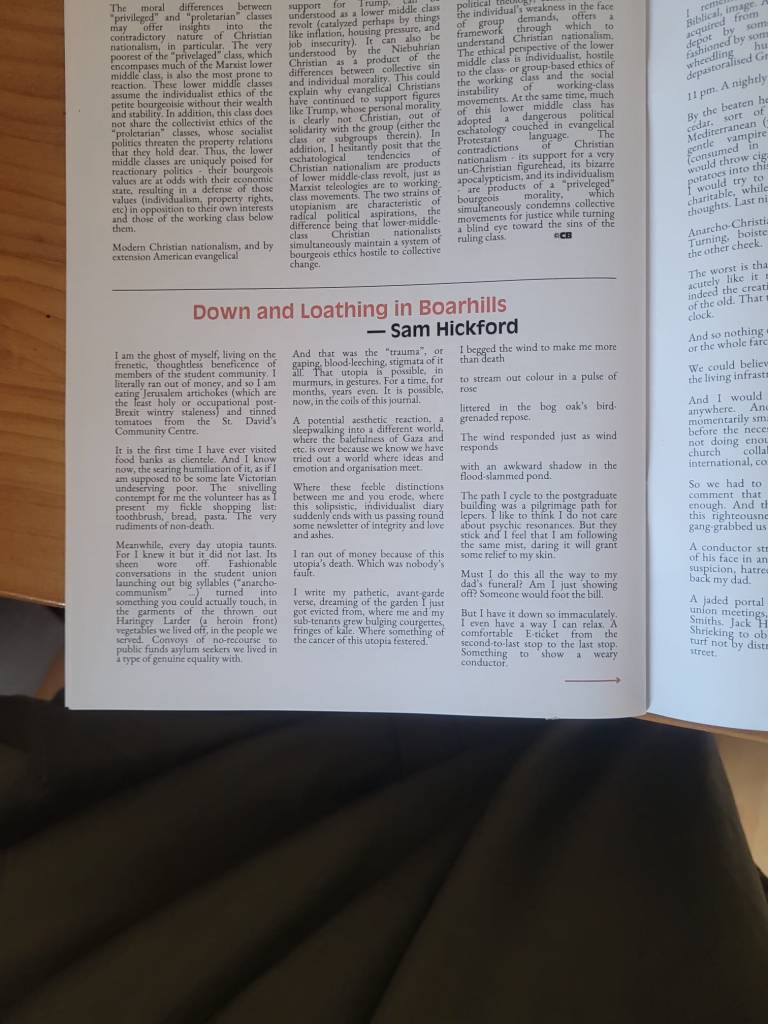
I am working on something called Down and Loathing in Boarhills. It is a work of fiction. An extract of it was published in Counterblast, a whirlwinding grassroots magazine seeking after authentic expression of injustice, doing more than others to grapple with the reality of our global human condition, the precarity of our artificial borders, and aiming to speak out in hopeful projectiles. It can be found here, and some physical copies can be purchased: https://counterblast.uk/. Peace, Sam.

