Struggling upwards through the fire

Fascinating to see what books manifest in Value Village in Pembroke, Ontario, which I discover is the only institution resembling a British charity shop that is to any degree widespread in this huge country. Trawling through knock-off editions of British classics – abridged Jane Austens etc. – I discover Ragged Dick and Struggling Upwards, by Horatio Alger, Jr.

The book has been written in, angrily, by some Eastern Ontarian Marxist, who connects this writer (unknown to me, at the time of trawling) to an entire doctrine. “Contrary to the Horatio Alger myth” – so the mysterious hand copies – “The Alger Hero’s improvement in station is not brought by hard work; rather, success invariably comes through the intervention of a wealthy gentleman for whom he happens to perform some act of bravery.” This is apparently found in Silvery, Children’s Books & Their Creators.

Before I do indeed burn the lamentable book on the fire, allowing it to struggle upwards in flames, I did use it as a vehicle of pondering. I have been thinking a lot about dialect; everybody speaks in some kind of dialectal way, and nobody speaks as text (if that makes any sense); even Received Pronunciation is derived from some kind of hodgepodge dialect; so why is it we have to so adamantly draw attention to certain bits of dialect, so the reader struggles as much as possible to make it out? This is apparently called “eye dialect”: as G.P. Krapp explains in the first usage, it is a “friendly nudge” to the reader, rather than a “genuine difference in pronunciation”. It is a joke, an orthographical convention alone, a reminder to the reader of the principles of genuine orthography. One of the amusing usages on OED is an inverted parody of RP, using “shiteing” to represent the way “shouting” is rendered in orthography.

In other words, “eye dialect” – I suppose an oxymoron – only makes sense in some kind of structural relationship to an author who clearly does know “how to spell”, or at least has some awareness that one is supposed to spell correctly. In Tales of Chemical Romance, by Irvine Welsh, protagonist Freddy’s attestation to a drug dealer he is “foine, me old mucker” reminds us, with “eye dialect”, we have entered squarely the realm of an anti-hero. Freddy, who works with corpses, comically objectifies the dead, and the vernacular observations underpin his not entirely intellectual-clinical attitude towards them:

Freddy ran his hand up the perfect one. It felt smooth. – Still a bit wahrm n arl, he observed, -bit too waarm for moi tastes if the truth be told

In other words, the writer is required to take an almost Stylitic position of snobbery, where dialect here communicates we are in the territory of an authentic weirdo.

Eye dialect exists in those writers who do write in “standard English”, but want to keep their hand in with the vernacular. How this functions in poetry is more complicated, since poetry is supposed to bear the closer stamp of speech. I guess it ramps up the raw speechiness of poetry? Robert Service’s Rhymes of a Red Cross Man ­features this technique, throughout the ironically titled “The Odyssey of ‘Erbert ‘Iggins”:

Me and Ed and a stretcher
      Out on the nootral ground.
(If there’s one dead corpse, I’ll betcher
      There’s a ‘undred smellin’ around.)
Me and Eddie O’Brian,
      Both of the R. A. M. C.
“It’as a ‘ell of a night
For a soul to take flight,”
      As Eddie remarks to me.
Me and Ed crawlin’ ‘omeward,
      Thinkin’ our job is done,
When sudden and clear,
Wot do we ‘ear:
      ‘Owl of a wounded ‘Un.

Dialect is viscera, earthiness, in other words – it is an escape from the manacles of propriety. World War I-era  poets Robert Service, David Jones, Wilfred Owen, T.S. Eliot etc. all use dialect in poems about the Great War, situating us there in the ordinariness of a couple of young lads talking, about to die. For Owen and Service this is poetry exclusively in dialect that hits us like a shell when we are consuming otherwise non-dialect poems, sonnets and the like. Mancunian dialect, for example, is employed by Owen in “The Chances”, where one of the Manchester Regiment delivers a “dramatic monologue”:

                I mind us ‘ow the night before that show
                Us five got talking – we was in the known

In other words, “dialect” is always self-conscious in poetry, or dialect ossifies into self-consciousness in poetry. This might be the best way of understanding even John Clare, who steadfastly holds on to his own dialect to describe the  natural world, even when the dialect region he grew up in – the North Northamptonshire dialect infused environs of Helpston, Glinton, – has been altered beyond recognition; where much of what infused the dialect (dialect as circular, as recurring, as tied to an older agrarian rhythm) has been “developed”, enclosed. In “The Flight of Birds” – a poem of unimpeded movement in standard English – Clare surprises us with dialect terms:

                The crow goes flopping on from wood to wood,
                The wild duck wherries to the distant flood,
                The starnels hurry o’er in merry crowds,
                And overhead whew by like hasty clouds,

Clare knows that “starling” is the “right word”, but cannot help himself designating these starlings as our starlings, the starlings or “starnels” nested in the poem themselves. (This is not to remark on the wonderful precision of the wild duck wherries – a wherry is a light rowing boat. The movement is likened to a particular vessel, the word itself mimetic of the vessel, blah blah.)

What interested me about Ragged Dick, then, was the way in which, contrary to these positive uses of dialect, eye dialect was associated with bad education, and the character’s maturity is linked to their learning to unknot themselves from their charming native dialects. Ragged Dick is extricated from shoe shiningness with honesty and trustworthiness, and part of his journey into respectable and boring clerical work is the losing, the loosening, of the diphthongs. Dick doesn’t want to expose the contents of his “valooable pocket book” to a woman accusing him of theft, in an act of irony, seeing as he has nothing: he laments that rich people have “private tootors”. All the time, we are meant to be aware of Dick’s potential for education, even as the eye dialect becomes more steadfast in its vocabulary, maturing to “destitoot” (“I’m in destitoot circumstances”), and “loocrative perfession”. All the time eye dialect is central to the irony, of the self-madeability of the New York accented Dick.

Eventually, we see the self-editing that Heaney claimed negatively made him write “Worked” instead of “Wrought” in “Digging”, an inculcated sense of the invalidity of one’s own dialect:

                Dick was about to say ‘Bully’, when he recollected himself, and answered, ‘Very much’.

Finally, Dick has learnt how to code-switch, but his retention of the dialectal Id, the voice that does initially urge him to use vernacular, is central to the self-made man’s double-nature.

Equally, as a temperance advocate, Alger connects the genteel voice that urges us to say ‘Very much’, milder than the impetus of our own dialect – apparently this occurs in Thomas Decker in 1600, “to please my bully king” – with restraint, forbearance – despite the illustrious history of the original adjective.

This might explain a little bit about US/Canadian society, more dialect spurning than British. I have been playing Scrabble obsessively recently, one of the many sins I am praying for deliverance from; in British scrabble, dialect and standard words mingle, ‘JO’ and ‘LOITERER’ are both high-scoring words for different versions, but the American is expunged of dialect. Is it part of the American psyche to connect dialect to an-education? Ee by gum, I’m not sure.

Equally, in the latter story within the Penguin edition of Ragged Dick and Struggling Upward, another story is included; “Luke Larkin’s Luck”. It is the highwaymen who harass our hero that use dialect, whose Puritan wealth-lusting virtue is embodied in his Standard English. Luke is saved by his Standard English gentility by being mild and virtuous enough to be taken pity on by the capitalists, who pay his mother to look after a child in response to deciding they like him because of such like qualities. Who save him.

Before throwing the book on the fire, (the cost of living crisis has reduced me thus), I remember what I realise now is an oddly ironic interaction with this book. I meet a little girl on a train, with her mother. With 50 minutes to kill, I proceed to try to teach the little girl how to read. I’m reading this book, and she starts writing her name on it, which I start correcting. Was I the capitalist, enforcing propriety and eye-dialect-erasure? And is the kind of equality real – the so-called Algeristic equality – that anyone at all is technically capable of advancing, with a concoction of skill and luck.

https://www.waterstones.com/book/poems-sketched-upon-the-m60/sam-hickford/9781912412334

“Assemblage” by Kassiopeia Bernays

This poem depicts a sequence of becomings, as if to tapestry.

Bright wings, momentarily concrete,
flicker in the turning, concentrated
within the branches’ fever. There is no grace
but this, traced in negative: wind’s imprint
and world’s reply. One trunk’s cry:
the broken promises made
to all which strains, becoming
towards light’s cradle.

Live hands, live sinews,
a bird skull scrawling its name
– calcified reason, stripped of the callings
of feather and flesh. And we are what is left:
pulse of symmetry, caught
between lichen’s bleached quarantine
and ocean’s answer. I feel the magnetism
of my loaned sea-metals, whole-sick,

but I must defend the narrowness
of this cave’s nerve tissue. Cohering
here, against the beating root-worm woven
and the premature harmony of siren strings
quivering, I huddle by green embers:
afterglow of blood-spark’s attempt,
for, by degrees, I am.

Responsible golfers; please oppose the Justin Timberlake and Tiger Woods Sports Bar in North Street

Since I was fourteen, and became politically awakened, my mates have all been ridiculous leftists. Together, we have called for mandatory omniequality, the stripping of all titles, the immediate restoration of the golden toad to its natural habitat, and the ushering in of the new anarcho-syndicalist era.

I’m therefore going to turn right away from them in this blog post, and gesture towards a different audience: reasonable golfers. Yes, if you’re a card-carrying leftist of any stripe or hue, this post is not for you. For, in my couple-of-years residence of St. Andrews, I have benefitted economically and personally from the golf industry. Despite this, the golf industry’s whoops and skirls certainly had me running from the hills at Fairmont Hotel, a five star hotel designed for such a demographic, where I encountered some of the most unreasonable members of the golfer subsection. These are the kind of guys who seemingly play golf so they can belittle, treating whacking on a ball on a cup as some improbable admission to an elite cadre of professional shirkers. The fact that golf was for half a millenium a deeply violent sport, involving frequent club-inflicted deaths, (I might have just made that up), definitely applies in this case. These guys will throw their clubs at you, demanding you behold their Titleist-emblazoned objects with the same avaricious glee that they themselves behold them. I have suffered, Reader, at their hands. I have been subjected to the most impolite behaviour, from someone DEMANDING a taxi to ‘Old Course Church’ (and refusing to believe that they meant ‘Old Course Hotel’), to hearing colleagues subjected to over-sprinkles of racist abuse and violence. I attribute some difficulties that were going on with me, emotionally, last year, to working in the Concierge department of the Fairmont Hotel, though I definitely interacted with some lovely people as well.

Working there, indeed, I could be angry at golf, with its cult of ecological destruction (golf courses, as they currently exist within this world, involve clearing vast tracts of precious forest, and have resulted in the destruction of many pristine ecosystems.) But working as a tour guide (and having a father and grandfather who are both reasonable, tolerant people, and have been involved in this unnamable sport) has given me a probably fatal belief that golfers can be good people. In Eat Walk Tours, I have met the cream of the crop: golfers who want to know about the history of St. Andrews before golf (the Reformation mafia drama being the reason that there is enough space for golf, for one,), to golfers who are interested, God forbid, in sustainability, respect, decency, equality, and fairness. I have become aware that such golfers exist, complicating any stereotype of golfers.

I am therefore addressing such golfers, when I am asking you to oppose the plans for this sports bar. There are enough spaces for golfers here – there is an entire 5* hotel, and an entire district of town taken up with their interests. What we have so precious little of the town in, however, is affordable business and housing. Soaring rents have displaced locals from the town, while there are simply not enough community spaces or affordable businesses, while they are plenty of businesses both in North Street and The Scores for golfers to cavort.

Well, I am saying, let all this continue. Provided they are inquisitive, and responsible, they are doing no strict harm. But this town is more than just golfers cavorting: it is an ordinary town in the beautiful Kingdom of Fife, with people with the ordinary needs of locals in any town. Efficient, functional hospitals, shops in which bread and milk can be purchased at a reasonable price.

And, so this cinema represented, entire spaces that are designed for the budgets of ordinary families and citizens. Places for people to bring their children, without having resort to Dundee etc. Community spaces where the non-mega-rich folk of the town can feel safe.

And that is why, all jokes aside, this Sports Bar is just not what this town needs right now. Golf money, so I have observed from direct experience, is not trickling to the ordinary people of this town. Wealth inequality is soaring on these Isles.
Please continue to play golf here. For your doing so has helped the town. But do so reliably and engagingly, being aware you inhabit a real town. And interest yourself in this town’s complexity and diversity, and its need for passionate social projects to relieve its cataclysmic wealth inequality. We are not – and, I repeat, repeat not, just the home of Golf. And we do not – and I repeat, not – need yet another business to venerate its post-reformation cult.

Please – please – do everything in your power to oppose the Justin Timberlake and Tiger Woods Sports Bar. The town needs you. Call instead for a community space, where the elite will let us live in this town. For once.

“Burial” by Anisha Minocha

In an early draft of this poem, this poem finds its anti-origin in the labour of burial, burial as an anterior quickening of memory’s meaning and miasma, burial as the flourishing and tapering of ghosts. Minocha returns to an earlier poem, embodying the putting-away or recycling of an earlier self.

Born sacred, peace by piece before
November’s war, this yellow thread
formed stardust and scattered ash
bends its head. A call towards the poem

My mother teaches me to recite –
this is the first and only poem
I wander lonely

Sit still daffodil, unborn bulb
Going back, here. Enwombed
in the fall of soil.

I know you already
uncaptured ruin. You waterfall,
refuse gravity. Remain rooted
under Grasmere’s cotton. You remain
weightless:

so every single summer
is a willing defeat to return
to her, and she says

You will live
You will live, again.

More budgeting tips in St. Andrews

  • Volunteer for Transitions, for StA Reuse, for the various community gardens around campus (by the Observatory / in St. Mary’s Quad / by the School of English / by Gannochy Hall / by Computer Science / etc.) Volunteering for the community gardens, you will become acquainted with what is growing, with the fresh produce there, what needs harvesting. On the other hand, volunteering for the reuse warehouse (a garage by the Chemistry Department), you will come to have a sense of what previous students are donating. The chances are that someone was unable to fit in a van back to Bridlington or Beijing the exact hoover, microwave, or combine harvester you are plotting in your mind. Everything apart from clothes is free in the St. A warehouse, so you will spend practically nothing on this.
  • Volunteer also for the various soup kitchens in town. You will definitely get entirely free food this way.
  • Try to avoid buying coffes and teas around town. There are lots of ways to do this. There are free hot water taps available in the Main Library, the Old Burgh School, and the PG Lounge in the Butts Wynd Building. But Greggs probably sells the cheapest and nicest coffees of all, at something like £1!
  • If something isn’t available in the Main Library that you need for an academic project, you can secure it by Inter Library Loans: https://libguides.st-andrews.ac.uk/InterLibraryLoans. You can secure practically any book this way. But be sure to return it in a timely fashion as you will be charged.
  • Also, you can get practically any book on archive.org.
  • Be attentive to what student societies are doing. Since these attract funding from the student union, they’re often able to run cheaper events. There are free yoga classes available with YogaSoc next week, for example, check their Facebook page. Sometimes the Sports Centre also runs free exercise classes. Etc. Blah blah.
  • CEX and Cash Converter in Dundee, which I forgot to mention before, sell second hand electronics, bikes, and watches.
  • Use Facebook Marketplace and freecycle fairly religiously to find what you need.
  • If you are not registered with a dentist, you can get free dental care from the University of Dundee: https://www.dundee.ac.uk/guides/get-treatment-dundee-dental-hospital. During term-time you ring up on the same day.

If you’d like to financially support me, please consider purchasing my book: https://www.waterstones.com/book/poems-sketched-upon-the-m60/sam-hickford/9781912412334.

Antisocial introverts guide to finding anywhere at all to study in St. Andrews

Martyrs’ Kirk (postgrads only)

Ostensibly the quietest place to study in town, with a culture of absolute silence, this library is perfect for extremely disciplined, silent, concentrated reading, or for a two-hour burst of thesis writing. I try to schedule a small burst of Martyrs Kirk – it’s a very potent, powerful, contemplative drug, and if you can only ever study in here you have the discipline of an ancient Carthusian mystic. You might find it annoying, for example, that there are no actual real books here that aren’t some sort of tome, or that there’s not even a space for light chatter somewhere off-stage.

Main Library

This gets very full in term time. There is supposed to be a quieter bit downstairs, with a little bivouac of a postgrad area, but it’s usually not very quiet, with reels of lads talking about their hunting ventures. You can book study spaces.

Byre Theatre

A former cow shed or whatever, people apparently study in here, but I’ve never fully understood why, with mills of the professional cultured class rifling through its plate-glass-stone faux-London beauty. It’s true, however, that it’s a big building, and you might be able to find somewhere to study on the second or third floor.

Old Burgh School

The home of St. Leonard’s College, this is a quiet building with a stable cast of people who know about it and work there. It’s a supportive community that feels reliably “adult” and enough like a workplace that you often feel guilty enough to get work done. Too much time there, however, might lead to chronic lack-of-inspiration-itis, as you forget that you are supposed to be at St. Andrews to be inspired, or half-inspired, not put together some sort of marketing Excel spreadsheet. If it’s any consolation, however, my son loves it here.

Outside

Should I admit to you, gentle, sensitive reader, infirm of heart, that I have actually done a huge amount of my PhD reading atop a croodling sycamore outside the Brutalist edifice of the Main Library? What I find handy about it is it’s proximity to the library, where the actual books are. But there are other outside locations where study may be carried out, such as St. Salvator’s Quad and a few church courtyards, such as just outside All Saint’s Church on North Castle Street, or on the East and West Sands. I have also done a huge amount of my work in a tiny little grove near Ayton House.

Cafés and pubs

I think the only pub or café I have ever worked in in town is Aikman’s. I have worked once or twice in The Canny Soul and the Granary Café in St Andrews Museum, both of which seem to be cafés that people don’t often meet for dates or gawp at gigantic statues of William and Kate in.

“Plantation Spell” by Emilie Challinor

Plantation Spell

Like a tooth it fell, or like a
tusk, lodged loosely in a gum, rootless,
slipped to prop against its neighbour.

There is always one, askew on the edge
of the pillared dark its fellows make, straight
and bottle-brush-wilted, but

some green moves yet – not leaf, but
there on needles pressed to softness,
an inchworm arches, finds purchase, relief –

as on my palm its teeth made new lines,
made creases questions, refused
to grip on plastic, nail or glass, as on the bark

now, on the trunk made whole by inattention,
let it open ridges into mysteries. Let it teach how to
remember you are an earth-made thing.

This is a literally oral poem: poem as struggling mouth, with all the attendant features of a child, wanting to speak. Challinor, or so I imagine, selects a gem from this oral ecosystem, understanding it as a glittering presence, trying, within the sagely magic of poetry (see Yeats etc. etc.) to slot it back into place. A felled pine may as well be our soul, with a few moment of child-kindling mysticism.

The poem jolts us back to the organic nature of ‘gum’, as if to chew is to contain the forest in the arboreal panorama of one’s mouth.

Every single budgeting tip in St. Andrews

I’ve lived in St. Andrews for a year and a half and had to care for a child while unemployed, then worked a combination of jobs while supporting myself as a delivery cyclist, PhD tutor, online tutor, and tour guide. I have never had a reliable, stable income nor any kind of PhD stipend. I had a tuition fee waiver, and that’s it. Nevertheless, survivalism in a town full of reality-divorced posh golfers can be a fun challenge. In case you’re about to be a similar position, here is every tip I can think of right now, though I know some more:

  • University of St. Andrews meal deal, available in the Main Library, Walter Bower House, and other University-run (not Union-run) cafés (somewhere in the North Haugh?). £1.75 for a reasonably priced sandwich, snack, and hot drink (filter coffee/tea). This has saved my life when I haven’t got the time to bring some food in a Tupperware (brandonym redacted?).
  • Tesco on Market Street have a reduced to clear section in the middle that often includes a diversity of food. They throw everything away at about 9 pm so get there before that.
  • Budget shops: There is an ALDI. That’s pretty much it, unless you count Greggs. But, In Dundee, there is a B&M and a Home Bargains. Make these your friends.
  • Similarly, if you’re too old for an Old Scot Card, bear in mind the University’s Stagecoach discount. You can get 75% off weekly tickets, which is a huge help. A weekly East Scotland ticket will cost about £7, which can get you to Edinburgh, Glasgow, Dundee, and possibly Aberdeen (staying out too late in Glasgow or Edinburgh may result in you getting stranded without the Elemy service, which is reasonably priced.). You need the St. Andrews logo to come up on your app. For help, go to the Main Library help desk.
  • Also, as a student, you are entitled to a 16-25 railcard even if you are over 25. This is important and will help a lot in getting to conferences, going home, etc. You need to go to the ASC and get them to stamp a physical railcard application, proving you’re a student, and then you’re off. It’s about £20 and well worth the money for a third discount on all standard tickets.
  • Bear in mind random soup kitchens, in St. Andrews churches, which happen a lot. St. Mark’s Parish Church, a Church of Scotland church near the bus station, has a free soup kitchen on Friday starting at 11 am. Don’t think that you are ‘taking food from people who truly need them by doing this. Considering how messed up the university sector is, you deserve free food, unless you have some sort of expensive trust fund, in which case maybe you should consider setting up something like this. There are more, too, and many in Dundee.
  • Similarly, St. David’s Community Centre, North East Fife Community Hub, near East Sands, on Albany Park, has an affordable lunch every weekday in which you can get a big lunch replete with much genuine nutrition for about £3. Food banks and a post office are run from here.
  • Bikes: Transitions have bikes you can borrow and a bike workshop where interested volunteers will help you repair your bike and not charge you extortionate sums. There’s a really nice chap on Kinnesburn Road who runs a bike shop called Cyclepath. Do not go to Spokes on South Street. These guys are notorious overchargers who will do whatever they can to ensure you pay overpriced sums for a simple and uncomplicated bike repair.
  • More on transitions. Transitions’ various community gardens have harvestable produce that is fit to bursting. Among the Transitions gardens that are easily accessible is a garden by the Observatory (nearby David Russell Apartments, where you may be.)
  • Similarly, Transitions run drop-in sessions in their garage on Monday and Friday from 12.30-2.30 by the back of the Chemistry department. This is often extremely nice stuff that posh students have got rid of. You can get virtually anything here – clothes, electronics, etc. I have got a blender, a wardrobe, and several furniture items for free here.
  • Use apps like Too Good to Go (which operates in St. Andrews) or Olio.
  • Consult In The Loop, the staff and PG newsletter. If you say you need something and make a case for why you might need it someone will often get in touch with you. I have acquired a washing machine and two sofas this way.
  • Housing: Landlords and landladies will often charge hefty prices, considering they know the housing game. Many of the student letting agents are notoriously immoral in terms of inflating prices. Look around for more ad hoc arrangements in Facebook pages like Get a Room. If you ask your department administrator to circulate a request for housing, something might come forward.
  • Also, near Leuchars, there is some amazingly cheap student accommodation nearby some army barracks. If you talk to student accommodation and say you are at risk of homelessness, they will move you here very affordably.
  • Castle Furniture Project in Cupar is supposed to be affordable and good. There’s also a similar shop like this in Anstruther.
  • Booze: Luvians (on Market Street) have a little expired beer box if you’re looking for something a little fancy to impress at a dinner party or posh student party, or just want to treat yourself, but, like me, are practically destitute. Obviously the Union is the cheapest pub in town, but you might feel a bit awkward in there unless you are 18, so consider other cheap pubs in town: Aikman’s, the New Inn (I think that’s about it.) Aikman’s sell a selection of Belgian beers for about half the price they’d be anywhere else, especially some bougie craft beer pub in Islington.
  • Books: try Transitions, Monday and Friday, an aforementioned drop-in session. Quite often if you are looking for course reading someone will be getting rid of them. I’ve taught EN1004 and have seen the entire EN1004 reading list, together, huddled in the Transitions drop-in session. There’s a second hand book shop on the other side of Market Street, near Luvian’s, which I mention because I bear a mortal grudge against Toppings, who won’t let me have a poetry reading there (if you’re reading this, Toppings, once I become a celebrity poet at the same level of Byron, I am never letting you stock my books. If you do I will take legal action against you.)
  • Swimming pools, blah blah blah: The Sports Centre is obviously your best bet, but maybe you want to consider working for the Fairmont? Lots of students work here and if you work for the notorious C&B department, often commandeered by UGs, you can simply sign up for particular shifts and not work any consistent or reliable shift pattern. And you then have access to the swimming pool! And also these ridiculous 30% discounts (or some figure to that effect) on stuff like massages, the restaurants (which are not that great), etc.
  • Obviously charity shops are in the town. I would avoid Oxfam, which is notoriously overpriced, though it does occasionally have these massive inexplicable discounts on nice coffee and chocolate.
  • Naturity has a bargain basket with stuff like soya cream for 75% off, as well as free vegetables.
  • Finally, I would strongly recommend a trip to Kinnessburn Eco Hub. A little bit out of town, this is a very affordable refillable shop, in which you can buy rice, shampoo, pulses, etc. I have bought a massive quantity of chickpeas, rice, and shampoo and honestly spent something like about £7.

  • More when inspiration strikes.

Poetic narcissism

(If you’ve enjoyed this, please consider buying my poetry collection, Poems Sketched Upon the M60: https://www.waterstones.com/book/poems-sketched-upon-the-m60/sam-hickford/9781912412334. I’m so poor that I eat from bins.

I recently had a very well-meaning and wholly lovely visit from a friend who advised me that the key to becoming a successful poet is a more coordinated PR campaign. My friend from school has also advised me this for years. I am entirely convinced that this is true, being excessively cynical about the world.

Equally, I don’t want this to be true and wish it would not, be true. Some of my earliest Facebook activity after recovering from the anodyne of a silent monastery a couple of years ago was directly ridiculing this notion. A juveniler me would tag myself at locations I’d never been to and write poems as if I was there, in direct and pretentious-prickish satire of the idea of a dramatic monologue. (I was recently called a pretentious prick, jokingly and banterously, twice, while giving guided tours around St. Andrews, so the term is on my mind a little.)

Maybe I can pinpoint what finally made me cave. Picture this scene, reader; FlixBus from Glasgow to Manchester, get in to Manchester Central Coach Station at 2.30 am, there’s a guy walking round the coach station shouting at everyone in sight, you get a coffee in a 24/7 SPAR. Then a security man in a High Viz Jacket tells you that you look “70% homeless”. You tell him that you teach at St Andrews, have a book. He says you need to buy some clothes from NEXT and then – in his words – “your students will be able to come to you”.

Maybe it is my incorrigible autism that just makes me not understand why going to NEXT is the next step towards “being taken seriously”. Are we seriously so blind towards the general import of what people are saying that we fixate on what brand they are wearing in order to decide whether or not to take them seriously? Fair enough that we think people with tattoos are cool, or that we think people with top hats are a little silly and antiquated. But having some sort of textile radar that can swoop into the whim of iron that a vestment has been branded with… surely this is a condition of late capitalism gone mad?

Maybe I’m still a bit angry at my very well-meaning boss’ boss, who flitted around the five star hotel I briefbriefbriefly worked in like an osprey, checking who hadn’t ironed their clothes and making a prey of them. Multiple times, despite doing my job very well and handling its multifaceted responsibilities well, and despite being good at schnozzing with rich people (a skill I never though I had, looking as 70% homeless as I do), it being precisely transferable to wiping arses in care homes, I was frequently given the slip by some complex chain of command that my presentation skills were not good enough. I missed a spot polishing my boots, I had urine all over my face, etc. etc.

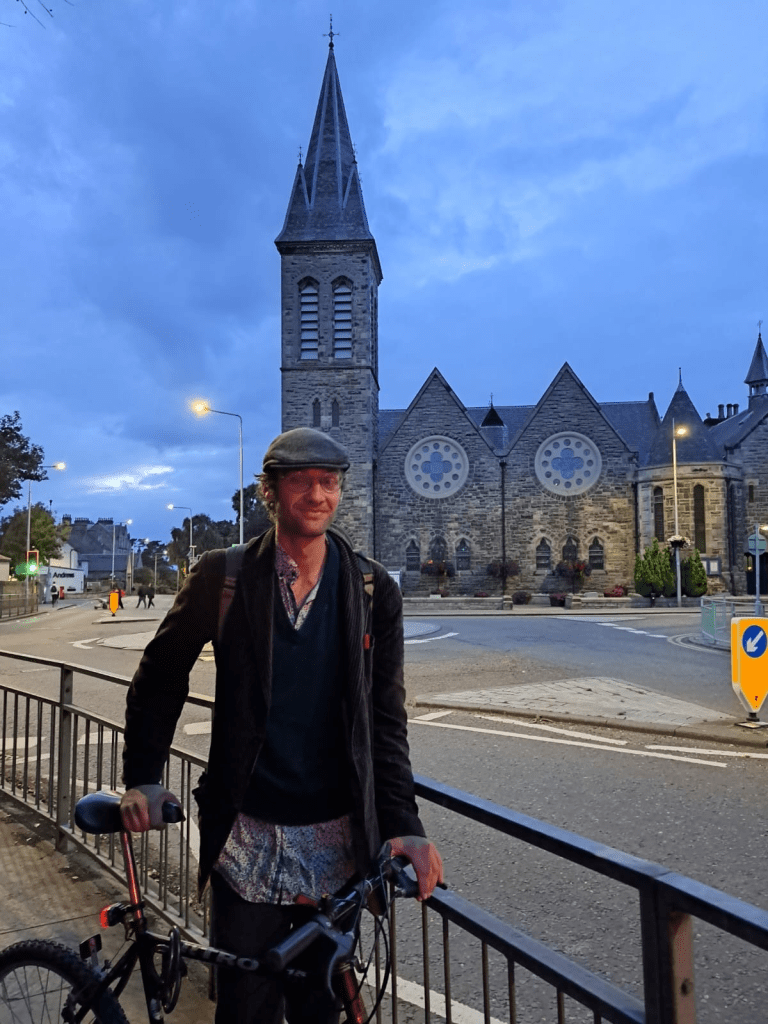
But I have caved, reader, and so this blog post is now just some pictures of me taken by someone else and an accompanying set of narcissistic photos. Isn’t that what you want? But you shall be given poems, that you shall not read, which is the only twist.


In the morning, let me know your love,

O megalith, for you spun this circus where

howls of racist abuse shall be our matins,

conical clouds will sing us from above.

And when all of this is in rabid disuse

what manner of vehicle serves to infuse

the whole temple of its plate-glass life?

Artificial fertility of stone-hewn

moss. A priory or two

to beat the sediment to dross

of spirit. Three hundred years

to imagine and relove.

The habitat’s trance, arboured

legacies of beyond pine

symphonies, starboard

new solitudes.

Will you accept my narcissism, God?

Meat the Vegans – actually innovative, creative vegan food

I’ve been vegan for ten years now. When I started it was specialist health food shops selling overpriced vegan food that you had to explicitly hunt for. Now being vegan is so much more accessible and trendy, but the ‘vegan market’ is saturated with samey and gimmicky food. The often dreaded ‘vegan meat’ largely looks like something vaguely resembling meat, with the tactile and olfactory consistency of cardboard. Recently, standards have fallen as supermarkets aggressively compete to corner the vegan-curious, offering fake meat products that are tantalising at first but unhealthy and bland.

I visited this restaurant with some friends in London. London is the worst culprit of this type of behaviour; ‘health food shops’ selling dreary vegan comestibles proliferate. In Camden, vegan offerings are absolutely full of poseur cuisine: overpriced experiences that should be paying you for the privilege of entering them.

So I was utterly surprised to wholly enjoy my time at this restaurant. I was staggered by the food, which is truly novel, innovative, and variegated. I had a vegan goat curry, which was the best meal I’ve had out in ten years; succulent and ambitiously structured. The waiting staff were full of genuine, rather than forced, warmth; the prices were modest.

Meat the Vegans is new, and needs support not to become another start-up erasure, so I’d really recommend doing everything you can to keep it afloat.