Responsible golfers; please oppose the Justin Timberlake and Tiger Woods Sports Bar in North Street

Since I was fourteen, and became politically awakened, my mates have all been ridiculous leftists. Together, we have called for mandatory omniequality, the stripping of all titles, the immediate restoration of the golden toad to its natural habitat, and the ushering in of the new anarcho-syndicalist era.

I’m therefore going to turn right away from them in this blog post, and gesture towards a different audience: reasonable golfers. Yes, if you’re a card-carrying leftist of any stripe or hue, this post is not for you. For, in my couple-of-years residence of St. Andrews, I have benefitted economically and personally from the golf industry. Despite this, the golf industry’s whoops and skirls certainly had me running from the hills at Fairmont Hotel, a five star hotel designed for such a demographic, where I encountered some of the most unreasonable members of the golfer subsection. These are the kind of guys who seemingly play golf so they can belittle, treating whacking on a ball on a cup as some improbable admission to an elite cadre of professional shirkers. The fact that golf was for half a millenium a deeply violent sport, involving frequent club-inflicted deaths, (I might have just made that up), definitely applies in this case. These guys will throw their clubs at you, demanding you behold their Titleist-emblazoned objects with the same avaricious glee that they themselves behold them. I have suffered, Reader, at their hands. I have been subjected to the most impolite behaviour, from someone DEMANDING a taxi to ‘Old Course Church’ (and refusing to believe that they meant ‘Old Course Hotel’), to hearing colleagues subjected to over-sprinkles of racist abuse and violence. I attribute some difficulties that were going on with me, emotionally, last year, to working in the Concierge department of the Fairmont Hotel, though I definitely interacted with some lovely people as well.

Working there, indeed, I could be angry at golf, with its cult of ecological destruction (golf courses, as they currently exist within this world, involve clearing vast tracts of precious forest, and have resulted in the destruction of many pristine ecosystems.) But working as a tour guide (and having a father and grandfather who are both reasonable, tolerant people, and have been involved in this unnamable sport) has given me a probably fatal belief that golfers can be good people. In Eat Walk Tours, I have met the cream of the crop: golfers who want to know about the history of St. Andrews before golf (the Reformation mafia drama being the reason that there is enough space for golf, for one,), to golfers who are interested, God forbid, in sustainability, respect, decency, equality, and fairness. I have become aware that such golfers exist, complicating any stereotype of golfers.

I am therefore addressing such golfers, when I am asking you to oppose the plans for this sports bar. There are enough spaces for golfers here – there is an entire 5* hotel, and an entire district of town taken up with their interests. What we have so precious little of the town in, however, is affordable business and housing. Soaring rents have displaced locals from the town, while there are simply not enough community spaces or affordable businesses, while they are plenty of businesses both in North Street and The Scores for golfers to cavort.

Well, I am saying, let all this continue. Provided they are inquisitive, and responsible, they are doing no strict harm. But this town is more than just golfers cavorting: it is an ordinary town in the beautiful Kingdom of Fife, with people with the ordinary needs of locals in any town. Efficient, functional hospitals, shops in which bread and milk can be purchased at a reasonable price.

And, so this cinema represented, entire spaces that are designed for the budgets of ordinary families and citizens. Places for people to bring their children, without having resort to Dundee etc. Community spaces where the non-mega-rich folk of the town can feel safe.

And that is why, all jokes aside, this Sports Bar is just not what this town needs right now. Golf money, so I have observed from direct experience, is not trickling to the ordinary people of this town. Wealth inequality is soaring on these Isles.
Please continue to play golf here. For your doing so has helped the town. But do so reliably and engagingly, being aware you inhabit a real town. And interest yourself in this town’s complexity and diversity, and its need for passionate social projects to relieve its cataclysmic wealth inequality. We are not – and, I repeat, repeat not, just the home of Golf. And we do not – and I repeat, not – need yet another business to venerate its post-reformation cult.

Please – please – do everything in your power to oppose the Justin Timberlake and Tiger Woods Sports Bar. The town needs you. Call instead for a community space, where the elite will let us live in this town. For once.

“Burial” by Anisha Minocha

In an early draft of this poem, this poem finds its anti-origin in the labour of burial, burial as an anterior quickening of memory’s meaning and miasma, burial as the flourishing and tapering of ghosts. Minocha returns to an earlier poem, embodying the putting-away or recycling of an earlier self.

Born sacred, peace by piece before
November’s war, this yellow thread
formed stardust and scattered ash
bends its head. A call towards the poem

My mother teaches me to recite –
this is the first and only poem
I wander lonely

Sit still daffodil, unborn bulb
Going back, here. Enwombed
in the fall of soil.

I know you already
uncaptured ruin. You waterfall,
refuse gravity. Remain rooted
under Grasmere’s cotton. You remain
weightless:

so every single summer
is a willing defeat to return
to her, and she says

You will live
You will live, again.

More budgeting tips in St. Andrews

  • Volunteer for Transitions, for StA Reuse, for the various community gardens around campus (by the Observatory / in St. Mary’s Quad / by the School of English / by Gannochy Hall / by Computer Science / etc.) Volunteering for the community gardens, you will become acquainted with what is growing, with the fresh produce there, what needs harvesting. On the other hand, volunteering for the reuse warehouse (a garage by the Chemistry Department), you will come to have a sense of what previous students are donating. The chances are that someone was unable to fit in a van back to Bridlington or Beijing the exact hoover, microwave, or combine harvester you are plotting in your mind. Everything apart from clothes is free in the St. A warehouse, so you will spend practically nothing on this.
  • Volunteer also for the various soup kitchens in town. You will definitely get entirely free food this way.
  • Try to avoid buying coffes and teas around town. There are lots of ways to do this. There are free hot water taps available in the Main Library, the Old Burgh School, and the PG Lounge in the Butts Wynd Building. But Greggs probably sells the cheapest and nicest coffees of all, at something like £1!
  • If something isn’t available in the Main Library that you need for an academic project, you can secure it by Inter Library Loans: https://libguides.st-andrews.ac.uk/InterLibraryLoans. You can secure practically any book this way. But be sure to return it in a timely fashion as you will be charged.
  • Also, you can get practically any book on archive.org.
  • Be attentive to what student societies are doing. Since these attract funding from the student union, they’re often able to run cheaper events. There are free yoga classes available with YogaSoc next week, for example, check their Facebook page. Sometimes the Sports Centre also runs free exercise classes. Etc. Blah blah.
  • CEX and Cash Converter in Dundee, which I forgot to mention before, sell second hand electronics, bikes, and watches.
  • Use Facebook Marketplace and freecycle fairly religiously to find what you need.
  • If you are not registered with a dentist, you can get free dental care from the University of Dundee: https://www.dundee.ac.uk/guides/get-treatment-dundee-dental-hospital. During term-time you ring up on the same day.

If you’d like to financially support me, please consider purchasing my book: https://www.waterstones.com/book/poems-sketched-upon-the-m60/sam-hickford/9781912412334.

Antisocial introverts guide to finding anywhere at all to study in St. Andrews

Martyrs’ Kirk (postgrads only)

Ostensibly the quietest place to study in town, with a culture of absolute silence, this library is perfect for extremely disciplined, silent, concentrated reading, or for a two-hour burst of thesis writing. I try to schedule a small burst of Martyrs Kirk – it’s a very potent, powerful, contemplative drug, and if you can only ever study in here you have the discipline of an ancient Carthusian mystic. You might find it annoying, for example, that there are no actual real books here that aren’t some sort of tome, or that there’s not even a space for light chatter somewhere off-stage.

Main Library

This gets very full in term time. There is supposed to be a quieter bit downstairs, with a little bivouac of a postgrad area, but it’s usually not very quiet, with reels of lads talking about their hunting ventures. You can book study spaces.

Byre Theatre

A former cow shed or whatever, people apparently study in here, but I’ve never fully understood why, with mills of the professional cultured class rifling through its plate-glass-stone faux-London beauty. It’s true, however, that it’s a big building, and you might be able to find somewhere to study on the second or third floor.

Old Burgh School

The home of St. Leonard’s College, this is a quiet building with a stable cast of people who know about it and work there. It’s a supportive community that feels reliably “adult” and enough like a workplace that you often feel guilty enough to get work done. Too much time there, however, might lead to chronic lack-of-inspiration-itis, as you forget that you are supposed to be at St. Andrews to be inspired, or half-inspired, not put together some sort of marketing Excel spreadsheet. If it’s any consolation, however, my son loves it here.

Outside

Should I admit to you, gentle, sensitive reader, infirm of heart, that I have actually done a huge amount of my PhD reading atop a croodling sycamore outside the Brutalist edifice of the Main Library? What I find handy about it is it’s proximity to the library, where the actual books are. But there are other outside locations where study may be carried out, such as St. Salvator’s Quad and a few church courtyards, such as just outside All Saint’s Church on North Castle Street, or on the East and West Sands. I have also done a huge amount of my work in a tiny little grove near Ayton House.

Cafés and pubs

I think the only pub or café I have ever worked in in town is Aikman’s. I have worked once or twice in The Canny Soul and the Granary Café in St Andrews Museum, both of which seem to be cafés that people don’t often meet for dates or gawp at gigantic statues of William and Kate in.

“Plantation Spell” by Emilie Challinor

Plantation Spell

Like a tooth it fell, or like a
tusk, lodged loosely in a gum, rootless,
slipped to prop against its neighbour.

There is always one, askew on the edge
of the pillared dark its fellows make, straight
and bottle-brush-wilted, but

some green moves yet – not leaf, but
there on needles pressed to softness,
an inchworm arches, finds purchase, relief –

as on my palm its teeth made new lines,
made creases questions, refused
to grip on plastic, nail or glass, as on the bark

now, on the trunk made whole by inattention,
let it open ridges into mysteries. Let it teach how to
remember you are an earth-made thing.

This is a literally oral poem: poem as struggling mouth, with all the attendant features of a child, wanting to speak. Challinor, or so I imagine, selects a gem from this oral ecosystem, understanding it as a glittering presence, trying, within the sagely magic of poetry (see Yeats etc. etc.) to slot it back into place. A felled pine may as well be our soul, with a few moment of child-kindling mysticism.

The poem jolts us back to the organic nature of ‘gum’, as if to chew is to contain the forest in the arboreal panorama of one’s mouth.

Every single budgeting tip in St. Andrews

I’ve lived in St. Andrews for a year and a half and had to care for a child while unemployed, then worked a combination of jobs while supporting myself as a delivery cyclist, PhD tutor, online tutor, and tour guide. I have never had a reliable, stable income nor any kind of PhD stipend. I had a tuition fee waiver, and that’s it. Nevertheless, survivalism in a town full of reality-divorced posh golfers can be a fun challenge. In case you’re about to be a similar position, here is every tip I can think of right now, though I know some more:

  • University of St. Andrews meal deal, available in the Main Library, Walter Bower House, and other University-run (not Union-run) cafés (somewhere in the North Haugh?). £1.75 for a reasonably priced sandwich, snack, and hot drink (filter coffee/tea). This has saved my life when I haven’t got the time to bring some food in a Tupperware (brandonym redacted?).
  • Tesco on Market Street have a reduced to clear section in the middle that often includes a diversity of food. They throw everything away at about 9 pm so get there before that.
  • Budget shops: There is an ALDI. That’s pretty much it, unless you count Greggs. But, In Dundee, there is a B&M and a Home Bargains. Make these your friends.
  • Similarly, if you’re too old for an Old Scot Card, bear in mind the University’s Stagecoach discount. You can get 75% off weekly tickets, which is a huge help. A weekly East Scotland ticket will cost about £7, which can get you to Edinburgh, Glasgow, Dundee, and possibly Aberdeen (staying out too late in Glasgow or Edinburgh may result in you getting stranded without the Elemy service, which is reasonably priced.). You need the St. Andrews logo to come up on your app. For help, go to the Main Library help desk.
  • Also, as a student, you are entitled to a 16-25 railcard even if you are over 25. This is important and will help a lot in getting to conferences, going home, etc. You need to go to the ASC and get them to stamp a physical railcard application, proving you’re a student, and then you’re off. It’s about £20 and well worth the money for a third discount on all standard tickets.
  • Bear in mind random soup kitchens, in St. Andrews churches, which happen a lot. St. Mark’s Parish Church, a Church of Scotland church near the bus station, has a free soup kitchen on Friday starting at 11 am. Don’t think that you are ‘taking food from people who truly need them by doing this. Considering how messed up the university sector is, you deserve free food, unless you have some sort of expensive trust fund, in which case maybe you should consider setting up something like this. There are more, too, and many in Dundee.
  • Similarly, St. David’s Community Centre, North East Fife Community Hub, near East Sands, on Albany Park, has an affordable lunch every weekday in which you can get a big lunch replete with much genuine nutrition for about £3. Food banks and a post office are run from here.
  • Bikes: Transitions have bikes you can borrow and a bike workshop where interested volunteers will help you repair your bike and not charge you extortionate sums. There’s a really nice chap on Kinnesburn Road who runs a bike shop called Cyclepath. Do not go to Spokes on South Street. These guys are notorious overchargers who will do whatever they can to ensure you pay overpriced sums for a simple and uncomplicated bike repair.
  • More on transitions. Transitions’ various community gardens have harvestable produce that is fit to bursting. Among the Transitions gardens that are easily accessible is a garden by the Observatory (nearby David Russell Apartments, where you may be.)
  • Similarly, Transitions run drop-in sessions in their garage on Monday and Friday from 12.30-2.30 by the back of the Chemistry department. This is often extremely nice stuff that posh students have got rid of. You can get virtually anything here – clothes, electronics, etc. I have got a blender, a wardrobe, and several furniture items for free here.
  • Use apps like Too Good to Go (which operates in St. Andrews) or Olio.
  • Consult In The Loop, the staff and PG newsletter. If you say you need something and make a case for why you might need it someone will often get in touch with you. I have acquired a washing machine and two sofas this way.
  • Housing: Landlords and landladies will often charge hefty prices, considering they know the housing game. Many of the student letting agents are notoriously immoral in terms of inflating prices. Look around for more ad hoc arrangements in Facebook pages like Get a Room. If you ask your department administrator to circulate a request for housing, something might come forward.
  • Also, near Leuchars, there is some amazingly cheap student accommodation nearby some army barracks. If you talk to student accommodation and say you are at risk of homelessness, they will move you here very affordably.
  • Castle Furniture Project in Cupar is supposed to be affordable and good. There’s also a similar shop like this in Anstruther.
  • Booze: Luvians (on Market Street) have a little expired beer box if you’re looking for something a little fancy to impress at a dinner party or posh student party, or just want to treat yourself, but, like me, are practically destitute. Obviously the Union is the cheapest pub in town, but you might feel a bit awkward in there unless you are 18, so consider other cheap pubs in town: Aikman’s, the New Inn (I think that’s about it.) Aikman’s sell a selection of Belgian beers for about half the price they’d be anywhere else, especially some bougie craft beer pub in Islington.
  • Books: try Transitions, Monday and Friday, an aforementioned drop-in session. Quite often if you are looking for course reading someone will be getting rid of them. I’ve taught EN1004 and have seen the entire EN1004 reading list, together, huddled in the Transitions drop-in session. There’s a second hand book shop on the other side of Market Street, near Luvian’s, which I mention because I bear a mortal grudge against Toppings, who won’t let me have a poetry reading there (if you’re reading this, Toppings, once I become a celebrity poet at the same level of Byron, I am never letting you stock my books. If you do I will take legal action against you.)
  • Swimming pools, blah blah blah: The Sports Centre is obviously your best bet, but maybe you want to consider working for the Fairmont? Lots of students work here and if you work for the notorious C&B department, often commandeered by UGs, you can simply sign up for particular shifts and not work any consistent or reliable shift pattern. And you then have access to the swimming pool! And also these ridiculous 30% discounts (or some figure to that effect) on stuff like massages, the restaurants (which are not that great), etc.
  • Obviously charity shops are in the town. I would avoid Oxfam, which is notoriously overpriced, though it does occasionally have these massive inexplicable discounts on nice coffee and chocolate.
  • Naturity has a bargain basket with stuff like soya cream for 75% off, as well as free vegetables.
  • Finally, I would strongly recommend a trip to Kinnessburn Eco Hub. A little bit out of town, this is a very affordable refillable shop, in which you can buy rice, shampoo, pulses, etc. I have bought a massive quantity of chickpeas, rice, and shampoo and honestly spent something like about £7.

  • More when inspiration strikes.

Poetic narcissism

(If you’ve enjoyed this, please consider buying my poetry collection, Poems Sketched Upon the M60: https://www.waterstones.com/book/poems-sketched-upon-the-m60/sam-hickford/9781912412334. I’m so poor that I eat from bins.

I recently had a very well-meaning and wholly lovely visit from a friend who advised me that the key to becoming a successful poet is a more coordinated PR campaign. My friend from school has also advised me this for years. I am entirely convinced that this is true, being excessively cynical about the world.

Equally, I don’t want this to be true and wish it would not, be true. Some of my earliest Facebook activity after recovering from the anodyne of a silent monastery a couple of years ago was directly ridiculing this notion. A juveniler me would tag myself at locations I’d never been to and write poems as if I was there, in direct and pretentious-prickish satire of the idea of a dramatic monologue. (I was recently called a pretentious prick, jokingly and banterously, twice, while giving guided tours around St. Andrews, so the term is on my mind a little.)

Maybe I can pinpoint what finally made me cave. Picture this scene, reader; FlixBus from Glasgow to Manchester, get in to Manchester Central Coach Station at 2.30 am, there’s a guy walking round the coach station shouting at everyone in sight, you get a coffee in a 24/7 SPAR. Then a security man in a High Viz Jacket tells you that you look “70% homeless”. You tell him that you teach at St Andrews, have a book. He says you need to buy some clothes from NEXT and then – in his words – “your students will be able to come to you”.

Maybe it is my incorrigible autism that just makes me not understand why going to NEXT is the next step towards “being taken seriously”. Are we seriously so blind towards the general import of what people are saying that we fixate on what brand they are wearing in order to decide whether or not to take them seriously? Fair enough that we think people with tattoos are cool, or that we think people with top hats are a little silly and antiquated. But having some sort of textile radar that can swoop into the whim of iron that a vestment has been branded with… surely this is a condition of late capitalism gone mad?

Maybe I’m still a bit angry at my very well-meaning boss’ boss, who flitted around the five star hotel I briefbriefbriefly worked in like an osprey, checking who hadn’t ironed their clothes and making a prey of them. Multiple times, despite doing my job very well and handling its multifaceted responsibilities well, and despite being good at schnozzing with rich people (a skill I never though I had, looking as 70% homeless as I do), it being precisely transferable to wiping arses in care homes, I was frequently given the slip by some complex chain of command that my presentation skills were not good enough. I missed a spot polishing my boots, I had urine all over my face, etc. etc.

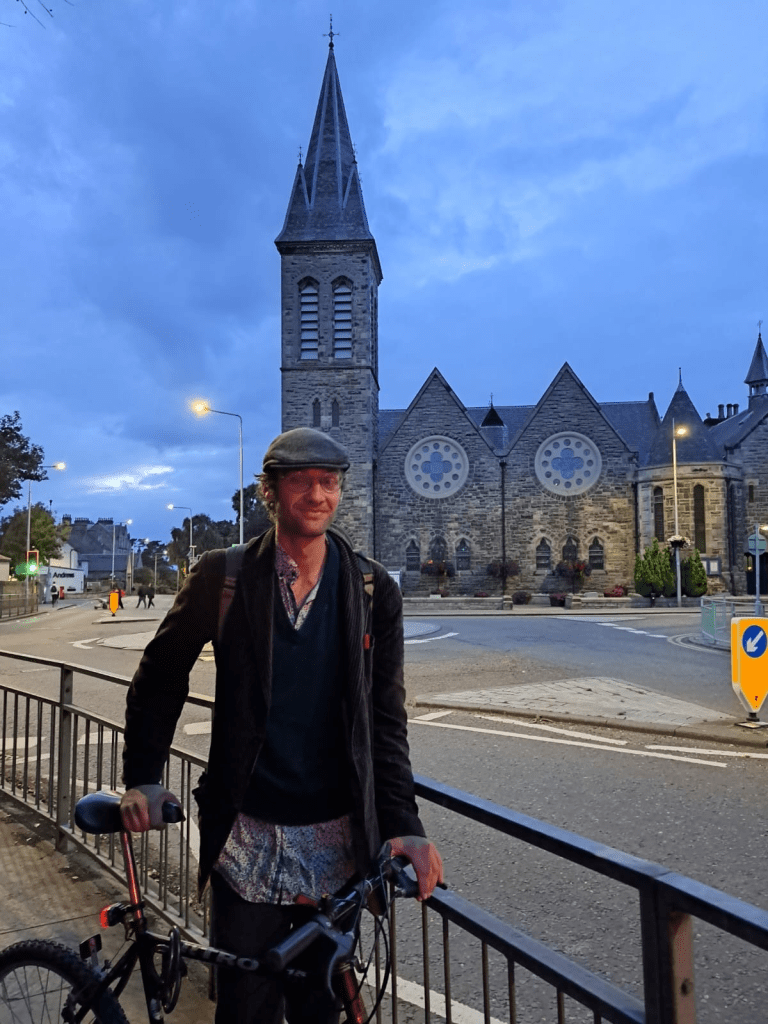
But I have caved, reader, and so this blog post is now just some pictures of me taken by someone else and an accompanying set of narcissistic photos. Isn’t that what you want? But you shall be given poems, that you shall not read, which is the only twist.


In the morning, let me know your love,

O megalith, for you spun this circus where

howls of racist abuse shall be our matins,

conical clouds will sing us from above.

And when all of this is in rabid disuse

what manner of vehicle serves to infuse

the whole temple of its plate-glass life?

Artificial fertility of stone-hewn

moss. A priory or two

to beat the sediment to dross

of spirit. Three hundred years

to imagine and relove.

The habitat’s trance, arboured

legacies of beyond pine

symphonies, starboard

new solitudes.

Will you accept my narcissism, God?

Meat the Vegans – actually innovative, creative vegan food

I’ve been vegan for ten years now. When I started it was specialist health food shops selling overpriced vegan food that you had to explicitly hunt for. Now being vegan is so much more accessible and trendy, but the ‘vegan market’ is saturated with samey and gimmicky food. The often dreaded ‘vegan meat’ largely looks like something vaguely resembling meat, with the tactile and olfactory consistency of cardboard. Recently, standards have fallen as supermarkets aggressively compete to corner the vegan-curious, offering fake meat products that are tantalising at first but unhealthy and bland.

I visited this restaurant with some friends in London. London is the worst culprit of this type of behaviour; ‘health food shops’ selling dreary vegan comestibles proliferate. In Camden, vegan offerings are absolutely full of poseur cuisine: overpriced experiences that should be paying you for the privilege of entering them.

So I was utterly surprised to wholly enjoy my time at this restaurant. I was staggered by the food, which is truly novel, innovative, and variegated. I had a vegan goat curry, which was the best meal I’ve had out in ten years; succulent and ambitiously structured. The waiting staff were full of genuine, rather than forced, warmth; the prices were modest.

Meat the Vegans is new, and needs support not to become another start-up erasure, so I’d really recommend doing everything you can to keep it afloat.

Titan, Michael Donaghy’s ‘Reliquary’

The robot camera enters the Titanic

And we see her fish-cold nurseries on the news;

The toys of Pompeii trampled in the panic;

The death camp barrel of baby shoes;

The snow that covered up the lost girl’s tracks;

The scapular she wore about her neck;

The broken doll the photojournalist packs

To toss into the foreground of the wreck.

This poem by Michael Donaghy, ‘Reliquary’, is now more pertinent than Donaghy could have ever imagined. I think the poem is about how we unwittingly or wittingly insert ourselves into the past – how we excavate to incavate. In a volta’s fire, “The broken doll the photojournalist packs / To toss into the foreground of the wreck” is woven into the perfect alternate rhyme structure of the poem itself, as we unknowingly are the wreck we claim the vanity of having distance from. What is historical becomes actual.

The title is bathed in irony – the line ‘The death camp barrel of baby shoes’, with its invented and disturbing concept of baby saints, does not quite step into regular pentameter: we ourselves are on the same awkward, jittery journey, reading this poem, re-re-reading about the Titanic, hearing that a submersible has imploded, re-martyred.

Everything up in the air, resisting short-haul flights, poems finally written in the clouds (Mile High Club?)

The plane is a fallow tear,

auto-drought to its carcass

in a graveyard of silhouettes;

mink whales wait for the burden

of a transplanted heaven.

This is an airport poem,

unmoored to the archaeology

of its destination:


Yeadon, or the native whitewash

of Misi-zaagiing,

It is not enough to acknowledge,

we pour faces into the commedia;

nature’s whiplash…

The physical process of carbon offsetting, the paying for some questionable subcontractor to plant ecosystemically inappropriate trees, is not enough, by any stretch; we have to also invent spiritual and aesthetic means of carbon offsetting. To truly, when we are on board a plane, picture the microdot in the landscape we breeze past, even while we are diverted by onboard entertainment facilities, and raze, or help to raze, with our trip; fully Ignatian-visualise the forest we have unearthed with our selfish aviation activities.

I make these pretentious statements because I myself am guilty. I have fasted from flying for ten years, despite really wanting to travel; wanting to do ecotourism in Costa Rica, wanting to travel to the wider Francophone world like Haiti and Martinique to encounter (always selfishly, always westernly) reality, wanting to visit friends in Romania. Wanting desperately to go to the US to discover the ‘heart’ of the Catholic Worker movement I am involved in (past tense? Involved?) Wanting to see biodiversity, to have a vision of why saving the world on a micro-scale in the UK in our woefully agro-businessified and bird-of-paradise-lacking island might matter. Maybe just wanting a holiday!

But I flew this month for the first time in ten years. Given my son lives in Canada, far away from the UK, it was my only way as not a rich man and not an experienced sailor or swimmer to visit him. The extent to which this was a big deal has been met by apathy, consternation, and patience by whoever I’ve happened to tell…

…Tethered to old Britannia

a single air traffic controller

waylays into mystery…

But I remember the odd liturgies of flying from family holidays, which I was fortunate enough to go on, the sacramental strip tease, the unnuding, the odd clangorous clawing sociability of a mystery, the nudging and jabbering as we machine-learn Icarus. But perhaps that’s what the myth means; human flight is always costed. We may have seamless, even quotidian flying, but it costs the earth, weighs down upon it.

Everyone I’ve spoken to assures me I’m relentlessly justified in getting a long-haul flight to see my son. Even so, even after having paid the ‘carbon offsetting’, I feel guilty. The airplane itself, marauding with the Southern English and English-speaking Canadians, becomes confessional.

One moment of odd mystical synthesis was reading that France have moved to ban short-haul flights for journeys that are under two and a half hours. This was accompanied by the realisation that Canada, unlike the UK, lacks a really substantial railway network. From what it seems, rail transport from one big Canadian city to another is modern and high-speed, but many big towns of 10,000 people lack a railway station. This is true in the UK (Heywood – St. Andrews – two examples that have touched me -) but these are minorities, and are always supported by an extensive bus network.

Another moment of mystical synthesis was the fact that German environmentalist protest groups, unlike XR and Just Stop Oil, are making really concrete demands. Asking, for example, for speed limit reductions.

I am a supporter of XR and Just Stop Oil. But this plane journey and this reading material made me reflect a lot on my trip on environmentalist action. Maybe the apocalyptic imagery won’t wash, and in line with disruption, activists need to be more precise.

I don’t know. But one thing I imagined would be that specifically disrupting flights from Manchester to London, for example, would be a precise and effective strategy. These are planes that categorically shouldn’t run – who in their right mind is flying a trip that such a high-speed rail link exists for? But people constantly are – there are two flights a day. This seems less of an economic necessity and more the need for a seamless journey. Disrupting short-haul flights would encourage a precise debate like this.

Equally, should we ban private jets? Or restrict their use for the rich and powerful? These are all measures that, one supposes, would make sense, would begin to trigger a wider movement towards climate equity.

Or is it in nuance that we fall? Should we be doggedly emotional, and insist on the sentimental and spiritual dimension of what we’re losing? Or should we both?

…A million screens

discourse

the procession

of an earing