
Wollstonecraft’s Original Stories from Real Life (1788) is a brutal insight into the reality of life in the eighteenth-century, designed as a whiplash of unmanicured reality for children of that era. The framing device is of children sitting around and gently listening to stories. But these stories are not happily-ever-after fantasies; they are stony lessons of the reality of deprivation. These stony lessons of the death of children and animals, inducing children to be moral and devotional, are accompanied by plates by William Blake; indeed, the whole of Songs of Innocence and Experience was published in 1794, doubtlessly influenced by the unvarnished reality that Wollstonecraft evokes, while William Wordsworth and Samuel Taylor Coleridge’s Lyrical Ballads was initially published in 1798.
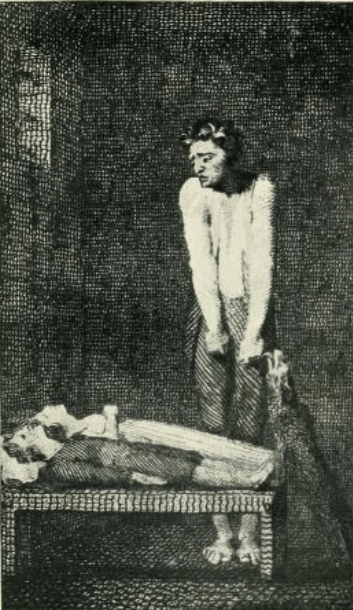
The idea of imagining late-eighteenth century children actually accessing these stories is to follow their radicalisation, tracing a childish joy in nature spun into an awareness of the horrors of rural poverty. The stories evolve gesturally from real locations; care-givers point out locations, and places, and begin to tell anecdotes about them. One example is Chapter Three; the children “bound over the short grass of the common”, until their eyes rest on the “broken side of the mountain”. Here Mrs. Mason, the apparently slightly sadistic educator, tells the story of “Crazy Robin”. Robin starts his life on good terms; he marries an unnamed woman, has a large family, and borrows a “trifle”. Everything’s going well for Robin, but ten or twelve years later, he is reduced to bizarre patterns, piling stones by the side of a brook, with the accompaniment only of a “cur dog”. In quick motions, Robin’s luck has turned suddenly; all of his children are dead, and he has been thrown into a debtor’s prison, a “gaol”, while his wife was “lying-in of her last child”. While Robin’s wife is deliberately unnamed, the way in which childbirth scars her body is woven into the story. With Robin in gaol, Robin’s wife tries to support her children through manual labour, but catches a cold, which turns into a “putrid fever”, and two of the children die, bringing with them a “cur dog”. Two children, Jacky and Nancy, remain, (two children, who, unlike Robin’s wife, are given the luxury of names), and follow their father to an unnamed prison. In a grotesque touch of hyper-realism, the two children then catch “jail fever”, usually now believed to be typhus, which was common in overcrowded, unsanitary English prisons, and die. Robin looks upon the corpses of Jacky and Nancy in “speechless anguish”.
We then cut to Mrs. Mason finding Robin dying, with only this cur dog for company, and therefore plunge back into where this anecdote is actually being told. Robin is dying, and Mrs. Mason nurses him as he dies. Robin has become one with the “cur dog”, living on “haws and blackberries”, and every kind of “trash”. This sense of botanical detail is important, and indicates Wollstonecraft has really got out; Robin lives off “nosegays of wild thyme”. This compounds our knowledge of Robin’s suffering when we learn that Robin’s dog tries to run after the horse of a “young gentleman”. In an act of class-based violence, emotionlessly treating this beloved cur as nothing more than an intruder, this “young gentleman” “levelled his gun at [the dog’s] head — shot him — and instantly rode off”. Mrs. Mason tries to find Robin again, and he is beholding his dead dog; then “nature was exhausted — and he expired”.
But the relentless cruelty of this chapter, really wanting us to see, hear, and feel the social conditions of the time, advances with the savageness of the framing device. In a touch that mirrors Geoffrey Chaucer’s The Canterbury Tales, Mrs. Mason then competes to tell the child, “Mary”, who exclaims “poor Robin!”, an even more horrendous story, to inspire her with emotive reason and coax her to think about the interdependence of human and animal. Again, Wollstonecraft here plays with the conventions of naming. Mrs. Mason now tells a story to the broody children of a figure who was hauled into the Bastille. As this is an instructional manual for children, Mrs. Mason has to explain that this famously brutal jail was indeed a jail, just like the one Crazy Robin was hauled into. In the Bastille, the unnamed figure, who does not nearly have the same colour as Robin, domesticated a spider within the solitary confinement of his prison cell over the course of “two or three years”. But rather than a heart-warming Steve Coogan film, the keeper crushes the spider, and the prisoner is left in a prison cell completely abstracted from the broader ecosystem. There is only his own non-monastic isolation; “that he breathed where nothing else drew breath”.
What this made dazzlingly clear to me is the extent of Wollstonecraft’s ecological thought. The greatest freedom for human beings is the ability to cultivate companionship with their fellow-creatures. This ecological thought forms the bedrock of A Vindication of The Rights of Women (1792), Wollstonecraft’s famous work, usually considered a proto-feminist text. Here, Wollstonecraft recycles this image of a figure in solitary confinement in lambasting the solitary confinement in which eighteenth-century women are kept. Her point is that women are held in unnatural, anti-ecological subservience; “To preserve personal beauty, woman’s glory! the limbs and faculties are cramped with worse than Chinese bands, and the sedentary life which they are condemned to live, whilst boys frolic in the open air, weakens the muscles and relaxes the nerves.” Wollstonecraft’s Original Stories was the launchpad both for this image and for Blake’s “mind-forged manacles”; we can only think of the barefoot, Dantescan Robin, lamenting his unnamed wife.
In turn, however, Wollstonecraft’s image of the spider in the prison cell is drawn from William Cowper. (I myself experienced something similar once; I was in St. Hugh’s Charterhouse and a bat came into my cell, thought I never tamed it). In Wollstonecraft’s The Female Reader: Or Miscellanous Pieces in Prose and Verse (1789), Wollstonecraft’s ecological sensibilities are further on display. In her introduction, Wollstonecraft celebrates particularity, bemoaning those who, “trace the great outline of nature, but neglect the colouring which gives warmth and beauty to the piece”. She invokes a pastoral image of Heaven, calling it an “awful close”. The Female Reader is an anthology, featuring a section called “Descriptive Pieces”. These “Descriptive Pieces” are radical, both literally and politically. One of these pieces is William Cowper’s “Tenderness for Animals”, contrasting the psalmodic “bounding fawn that darts across the glade” with “cruel man”, and the “savage din of the swift pack”. It seems plain here Cowper is criticising the cruel blood sports of the late-eighteenth century; Cowper criticises “detested sport / that owes its pleasure to another’s pain; / That feeds upon the sobs and dying shrieks / Of harmless nature”. For Cowper, he who hunts “disturbs th’Economy of Nature’s realm”, in an image that seems strikingly ecological and modern. But it is from Cowper’s “Bastille” that Wollstonecraft borrows in The Original Stories. Cowper uses a similarly Biblically-laden image of a prisoner who tames a spider to relieve the dull monotony of his chains:
To turn purveyor to an overgorg’d
And bloated spider, till the pamper’d pest
Is made familiar, watches his approach,
Comes at his call, and serves him for a friend
The improbability of this kinship is turned into an excoriation of the way men subjugate each other, giving them no companions but a spider. Cowper’s speaker protests:
That man should thus encroach on fellow man,
Abridge him of his just and native righis,
Eradicate him, tear him from his hold.
It was from Cowper that Wollstonecraft refined and reworked the industrial image of shackles and fetters that we now instinctively recognise and respond to. We might think of the way, in one of John Clare’s later poems entitled “The Skylark” within the Knight Transcripts, Clare shares his cell with a hallucinatory skylark, whom he addresses: “Although I am in prison / Thy song is uprisen / And singing away to the cloud”. The forthcoming The Complete Works of Mary Wollstonecraft will open up Wollstonecraft’s hybridistic thought and her contributions to both devotion and ecology, pointing out the debt that the canonical Romantic poets of the late eighteenth and early nineteenth century owe to her novelistic prose.
(My book, John Clare’s Modern Eco-Poetic Legacy in English, is out on 26th October, 2026): https://www.routledge.com/John-Clares-Modern-Eco-Poetic-Legacy-in-English/Hickford/p/book/9781041209126.)


Very thought-provoking! Thank you for writing this.
LikeLike